Posted on

ARCHIPELAGO at The Bodleian

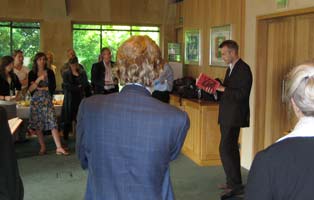
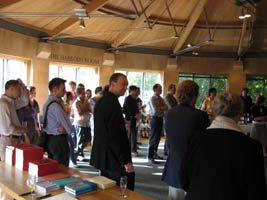
On Tuesday 9th October the Bodleian Library, Oxford, hosted an evening to celebrate the publication of ARCHIPELAGO and to mark the acquisition of the Clutag Press archives from conception to the present. The evening included readings by a number of contributors to Issue One, including Seamus Heaney.

The Bodleian also chose this event to launch its first series of BODcasts, which are now online and available for all to re-live what was a truly wonderful evening. Our thanks go to all those at the library who’s efforts made this auspicious evening possible.

To access the BODcasts click here

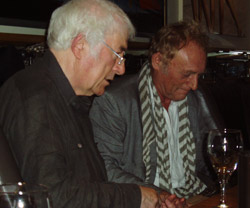
The photos shown here were taken at the pre-event drinks.

Posted on

ARCHIPELAGO in The Guardian

Robert Macfarlane writes of all things archipelagic in The Guardian, Saturday 14th July, including reference to Clutag’s ARCHIPELAGO:

“Last month saw the appearance of a new journal called Archipelago, with which I have been involved. It was conceived of and is edited by the poet Andrew McNeillie, and its original aims were to provide a home for the new archipelagic art, and to inspire and embody a return to the land – and seascapes – of these islands. It is impressively rangy in terms of form (reportage, criticism, poetry, photographs and artwork) and language (English, Welsh, Gaelic, Russian and Anglo-Saxon). Established artists presenting new material include Seamus Heaney, Roger Deakin, Derek Mahon, Michael Longley, Bernard O’Donoghue, the painter Norman Ackroyd, the artist Julian Bell, the sculptor David Nash, and the photographer John Beatty. The issue also carries the work of emerging young writers, among them the Welsh novelist Angharad Price, and the Oxford poet Paul Abbott.”

To read the complete article, click here.

Posted on

ARCHIPELAGO at Emmanuel College, Cambridge

The first issue of ARCHIPELAGO was successfully launched as part of the Passionate Natures conference held at Emmanuel College, Cambridge, 22-24 June 2007.

Readers included Andrew McNeillie (Senior Commissioning Editor, OUP, and Director of Clutag Press), Dr Leo Mellor (Fellow in English, New Hall College) and Robert Macfarlane (Fellow in English, Emmanuel College). They read from a selection of work by contributors including Roger Deakin, Seamus Heaney and Mick Imlah.

Look out for a feature on ARCHIPELAGO in the Guardian newspaper soon.

Posted on

Paul Abbott – FLOOD (Clutag Press, 2008)

Announcing the forthcoming publication of FLOOD by Paul Abbott with illustrations by Gail McNeillie, available February 2008

Limited edition of 100 copies.

22pp 170mm x 240mm  ISBN 0-9553476-2-9

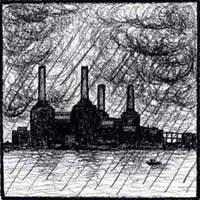
Paul Abbott’s poem FLOOD is a ‘Waste Land’ for the twenty-first century, a timely and daring debut in the disaster genre, by a twenty-one-year-old in his final year at Oxford. Those who have read the first issue of Clutag’s magazine ARCHIPELAGO will have enjoyed a snapshot of the poem in its pages. Now it is offered complete in ten sections, illustrated with eight superbly grainy drawings by Gail McNeillie. The vision here – ‘an Epic Newsflash’ – is one of post-apocalyptic catastrophe ‘couched,’ we’re told in a prefatory note ‘somewhat in the film-cutting style of Soviet montage theory (which I read about on Wikipedia)’.

Streetwise, slangy, irreverent, intensely self-aware (and well-read), the poet-speaker steals a boat (in very un-Wordsworthian circumstances), jumpstarts its outboard, and survives long enough to tell his tale ‘Of London, of Global Warming, of HEAT magazine… of squalid Thames… and of its fall’. The shades of William Blake and John Milton – ghost writers – act as Virgilian guides, ushering him towards ‘the first day of the rest
of my death’, at Battersea Power Station (the service entrance to hell).

Don’t miss it.

Price:

UK & Ireland £10.00 plus £2.50 postage

ROW £15.00 (incl. postage)

[wpsc_products product_id=’612′]

Posted on

ARCHIPELAGO Issue One

Announcing the forthcoming publication of ARCHIPELAGO Issue One, available Summer 2007

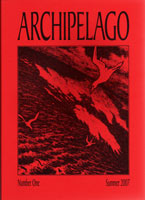
ARCHIPELAGO is to be a literary magazine in the ordinary sense, in that it will contain writings in non-fictional prose, and verse. Extraordinary will be its preoccupations with landscape, with documentary and remembrance, with wilderness and wet, with natural and cultural histories, with language and languages, with the littoral and vestigial, the geological, and topographical, with climates, in terms of both meteorology, ecology and environment; and all these things as metaphor, liminal and subliminal, at the margins, in the unnameable constellation of islands on the Eastern Atlantic coast, known variously in other millennia as Britain, Great Britain, Britain and Ireland etc; even, too, too readily, the United Kingdom (including the North of partitioned Ireland), though no such thing ever existed, other than in extremis during wartime, but in the letter. But while the unnameable archipelago is its subject, its vision is by implication global, and its concerns with the state of the planet could not be more of the hour.

The first issue features contributions by: Paul Abbott, Norman Ackroyd, John Beatty, Julian Bell, Roger Deakin, Greg Delanty, Seamus Heaney, Mick Imlah, Nicolas Jacobs, Andrew Kahn, Michael Longley, Robert Macfarlane, Derek Mahon, Osip Mandelshtam, Andrew McNeillie, Gail McNeillie, David Nash, Bernard O’Donoghue, Angharad Price and Mark Williams.

ARCHIPELAGO is published by Clutag Press and will be launched at Emmanuel College, Cambridge, on 23rd June 2007. Orders will be supplied strictly on a first come first served basis, and will not be despatched before the launch date.

(110pp 170mm x 240mm)

[wpsc_products product_id=’438′]

Posted on

Tom Paulin – The Camouflage School (Clutag Press, 2007)

Announcing the forthcoming publication of The Camouflage School by Tom Paulin, available Spring/Summer 2007

Limited edition of 250 copies.

36pp 170mm x 240mm  ISBN 0-9553476-0-2

The five poems in this important collection – ‘Sidney Philip’ (a poem about Philip Larkin, his father and the war), ‘Battle of the Atlantic’, ‘My Name is Edward Wadsworth’, ‘Convoy to Archangel’, ‘Noor Inayat Khan (S.O.E. Dachau)’ – are all published here for the first time. They show Tom Paulin writing as movingly, passionately, and inventively as ever he has written before. Part of his continuing ‘loose-leaf’ epic of the Second World War, begun in 2002 with The Invasion Handbook, these poems bear unflinching, compassionate witness to the tragedy of war, and in particular the special horrors of war at sea.

Paulin’s canvas is as wide as the Atlantic – that ‘great lens… watching us till the storms / we crave burl and wrap us / from the U-boat’s single eyes’. But his response to individual suffering could not be more particular, more moving or profound, more intuitive in its sympathies, more felt in its self-awareness, whether regarding a drowned merchant seaman ‘Known unto God’, or a victim of Dachau. These poems are strikingly graphic and brilliantly asociative in their visual imagery.

The collection’s title derives from a poem about the artist Edward Wadsworth. Recruited with others – ‘Vorticists and Futurists all’ – to a project ‘deep in the Liverpool docks’ devoted to creating ‘dazzle-ships – / so that what was wide / was also tall’, Wadsworth and his colleagues are said to have brought their studios ‘and Europe’s galleria’ to the Atlantic. Their purpose there is to create a visual dérèglement, to foil the periscope’s searching eye. Throughout the collection, but most notably in this poem, where modernity at its most barbarous press-gangs modernism into service, aesthetics and poetics engage, as the tragic subject of war dictates, with ideas of artistic integrity, perception and conscience.

Price:

UK & Ireland £20.00 plus £2.50 postage

ROW £25.00 (incl. postage)

[wpsc_products product_id=’614′]

Posted on

Ian Niall: Part of his Life

Announcing the forthcoming publication of Ian Niall: Part of his Life by Andrew McNeillie, available March 2007

‘…We owe Andrew McNeillie a great debt for reintroducing us to the most neglected of writers.’

Douglas Gifford

Ian Niall was the pen name of John McNeillie (1916-2002). Between them they wrote more than forty books, over a period of as many years, from 1939 when at twenty-two John McNeillie published Wigtown Ploughman: Part of His Life, with Putnam of London and New York, a Scottish classic still in print, a book that raised a national controversy, leading to housing reform.

As Ian Niall, author of the novel No Resting Place (1948), filmed in Ireland by Paul Rotha, he would go on to establish himself as one of the finest rural writers and observers of the natural world of his time, beginning in 1950 with The Poacher’s Handbook and reaching another high point in 1967 with his memoir A Galloway Childhood. He would also return to forms of fiction, now masterfully grounded in the facts of actual lives. Throughout, for forty years, Ian Niall contributed the weekly ‘Countryman’s Notes’ to Country Life magazine, acquiring a devoted readership that spanned the world.

But little did the majority of his readers know about the man behind the name. For he kept much to himself, a man happiest in the wilderness, but with the greatest feeling for common humanity.

[wpsc_products product_id=’544′]

Posted on

Geoffrey Hill – Poetry Reading CD

A recording of Geoffrey Hill’s poetry reading is now available on CD.  Details are as follows:

GEOFFREY HILL: POETRY READING, OXFORD, 1 February 2006

Poems from

FOR THE UNFALLEN (1959)

to

WITHOUT TITLE (2006)

Geoffrey Hill, in this recording made in Oxford on 1 February 2006, reads 33 poems selected from his entire oeuvre at that date. That is, from his first book For the Unfallen (1959) to his most recent, Without Title, published in January 2006.

[wpsc_products product_id=’646′]

Posted on

Mick Imlah – DIEHARD (Clutag Press, 2006)

DIEHARD by Mick Imlah, published Autumn 2006

Limited edition of 200 copies. 

32pp 170mm x 240mm  ISBN 0-9547275-9-2

Mick Imlah’s first gathering of poems for some years, DIEHARD derives from a larger, major work in hand called ‘The Lost Leader’.
These are extraordinary poems of wit and high intelligence, executed with formidable technical skill and honest feeling. They are like a lost poetic history of Scotland brought to light, a modern ironic history, from AD 500, by way of a guided tour of Iona, to yesterday at a Dumfries bus depot, from Fergus Mor to John Smith, from Michael Scot to Walter Scott. Imlah’s dramatising power, his eloquence, and gift for narration never fail him. Nor do his ear for the demotic and his delight in the comic.
There are excursions here, military and other, to Italy, Spain and England, tracing with sardonic humour the fortunes of Scotland’s sons and daughters, at home and abroad, through the centuries. Together the ten poems in this selection: ‘I (AD 500)’, ‘Michael Scot’, ‘Braveheart’, ‘Selkirk’, ‘The Queen’s Maries’, ‘The Honours’, ‘Diehard’, ‘London Scottish’, ‘The Four Marys of Melrose’: probe into Edwin Muir’s assertion (Imlah’s epigraph) that ‘… no poet in Scotland now can take as his inspiration the folk impulse that created the ballads, the people’s songs, and the legends of Mary Stuart and Prince Charlie. He has no choice but to be at once more individual and more local.’

The individuality of Imlah’s voice is not in question. But ‘individual’ and ‘local’ are hardly the measure of DIEHARD. These poems belong in the great tradition of Scottish poetry and of poetry the world over.

[wpsc_products product_id=’617′]

Posted on

Anne Stevenson – A Lament For The Makers  (Clutag Press, 2006)

Announcing the forthcoming publication of A Lament For The Makers by Anne Stevenson, available Spring/Summer 2006

Limited edition of 200 copies.

44pp 170mm x 240mm  ISBN 0-9547275-7-6

ANNE STEVENSON

‘…it is about time that she was recognized as one of the finest poets writing in English today.’

Times Literary Supplement

Author’s Preface:

A LAMENT FOR THE MAKERS is a dream poem conceived three years ago while I was looking out over the golden beech trees of October, reading Arthur Burrell’s version of Langland’s Piers Plowman in the Everyman Edition of 1912. The poem also owes its existence to Thomas Sackville’s The Complaint of Henrie, Duke of Buckingham, (c. 1563) and to the selection of medieval lyrics represented in the first volume of W.H. Auden’s and Norman Holmes Person’s Poets of the English Language, published by The Viking Press (New York) in 1950. I have made this treasury of poems my life’s companion ever since my mother presented me with its five small red volumes on my graduation from high school in that same year. Behind the Medieval dream tradition in which Chaucer and Langland wrote, of course, stands the Colossus, Dante, whose Divina Commedia I read in Italian (with a crib in the Temple Classics) when an undergraduate at the University of Michigan; those old editions of Dante, too, are still in my possession.

The Lament, however, began to take its present form after a real dream. When Peter Redgrove died in the summer of 2003, The Times newspaper asked me to write an obituary, a request I had to refuse for all sorts of reasons. In a dream that night, Peter appeared and like a latter-day Virgil undertook to explain the nature of the afterlife. I cannot claim, however, that what I dreamed is what I quote him as saying in the poem. That came later, after I had re-read Redgrove’s poems and thought about them. Part II was written in the summer and early autumn of 2005, and the poets represented there were either friends, like Frances Horovitz, or poets I especially admire (Ted Hughes, Edward Thomas, Dylan Thomas, Philip Larkin), or poets I happened to find lines to fit. I do not consider that this Lament for the Makers is complete, but surely I have worked that three-line stanza – flexible as it is – hard enough. My present plan is to write further ‘movements’ in different shapes, moods and tempi, perhaps about different poets or different kinds of ‘makers’. To write any more, though, will take months and years of time, and I am not sure how much of that precious commodity I still have at my disposal. At the end of this ‘episode’ the narrator wakes from a night of troubled dreams to watch storm clouds roll away into a dawn that will, of course, lead to another night and different dreams. This seems a good place to halt, look around and listen out for whatever or whoever it is that next applies for a little space on the left bank of Lethe.

[wpsc_products product_id=’555′]