Posted on

Omnium-gatherum

Update:

Another superb new review of Lilliput Press’s Archipelago: A Reader (Edited by Nicholas Allen and Fiona Stafford) by Dan MacCarthy was published on 29th January 2022 in the Irish Examiner. Click here to read the review.

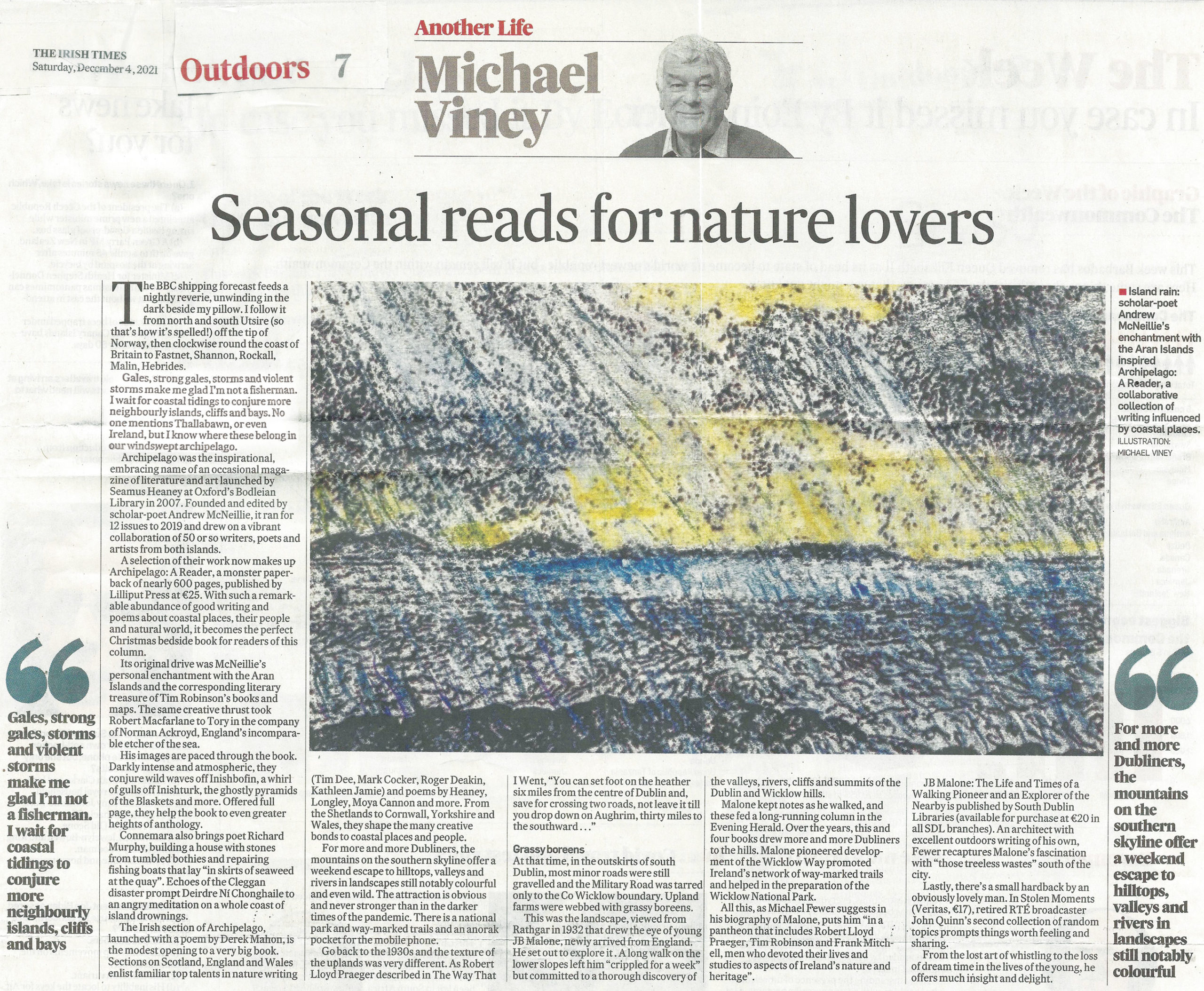
Further press coverage in the Irish Times from Saturday, December 4th 2021  (click on the image or  click here for a more legible version)
 

Omnium-gatherum

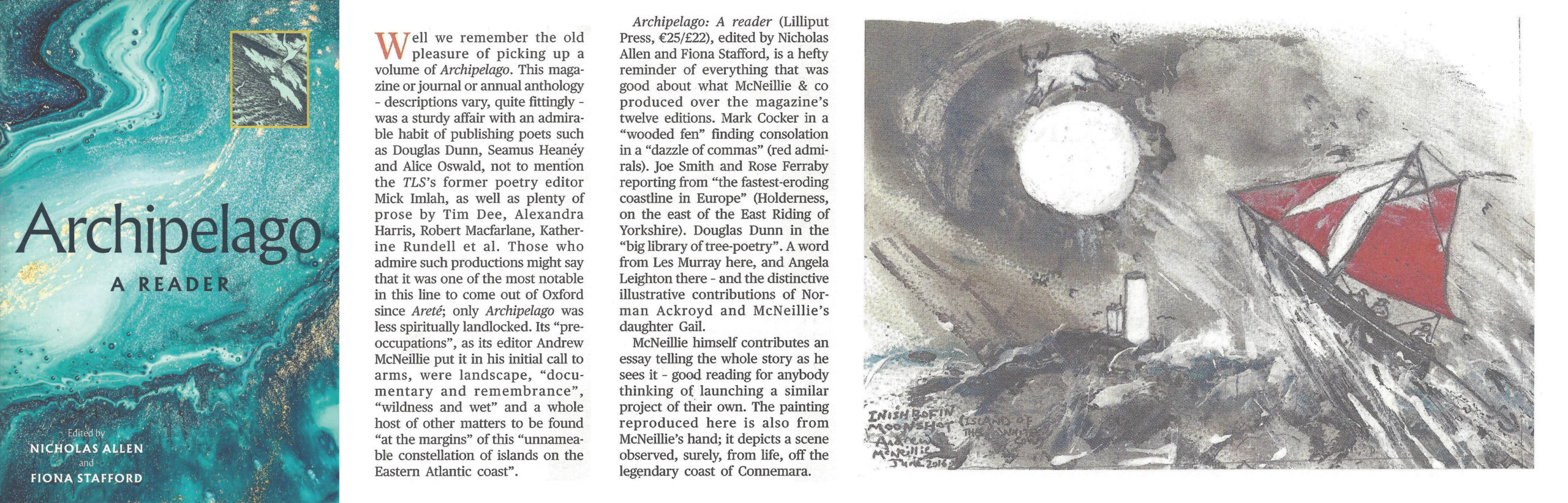
Here to remind you of Lilliput Press’s Archipelago: A Reader, edited by Nicholas Allen and Fiona Stafford, and launched in Convocation House, Divinity School, The Bodleian Library, Oxford, on 10 November, and by Zoom from the Dublin Literary Festival, the next day. Surely, the ideal Christmas present for all those of an archipelagic persuasion. Here’s what M. C. of the Times Literary Supplement  had to say about it:
Deirdre Ni Chonghaile made a landmark/seamark contribution to Archipelago 12, ‘Greim an fhir bháite’ (The grip of the drowned man). It is included in Archipelago: A Reader. Now she has an important new book out from University of Wisconsin Press.
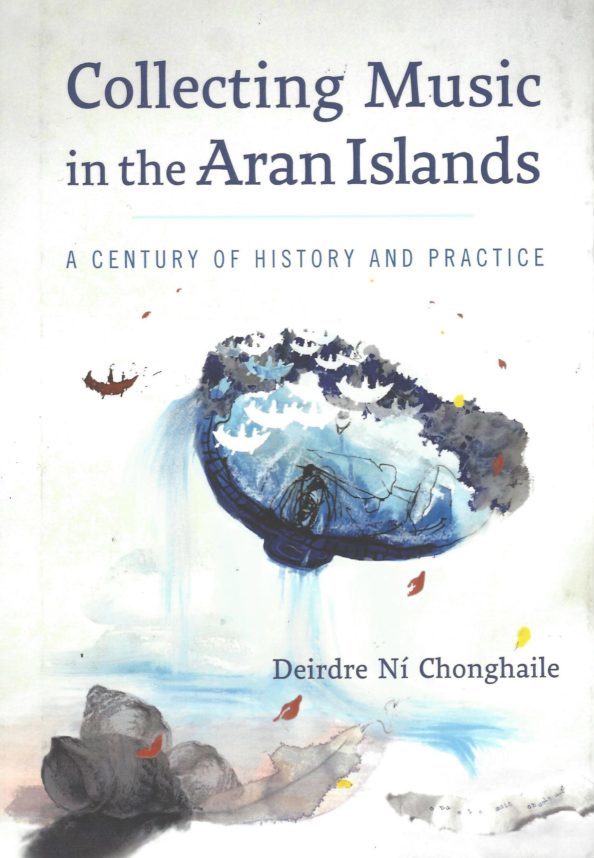
This book is a must for all serious students, and amateurs like myself, of Aran Islands cultural history. I guess that for many, as for me, J. M. Synge’s association with the islands and his musical interest in the people and their practice of Sean-nós singing (unaccompanied ‘old style’ song in Irish) represents just about the most we know about the subject, apart from any experience of contemporary performance on the islands and elsewhere in Connemara.

Ni Chonghaile has previously published an important essay on ‘Synge as Song Collector’ (Irish University Review). The account she now provides in Collecting Music in the Aran Islands is a story on a different scale, and a fascinating one.  Her book deals in detail with four historical collections including the seminal work of Douglas Hyde, most notably his Love Songs of Connacht that had great influence on Synge. It affords vital insights for the non-Irish speaker into what actually went on musically in Ireland, through (and orally, as must be, prior to) the nineteenth- and into the twentieth century, and the world West of the Shannon above all.


What part the practices of collecting and translating played in saving the Irish language is complex, if not impossible, to assess, but current ‘old style’ musical revivalism is strong among a new generation of native Irish language speakers. Without the devoted efforts of the collectors and their translations, however uneven and varied, whatever their understanding of, or ambitions for, what they were doing, all might have been lost on the air into which the songs were sung. There would only be work handed down in the last outposts of oral transmission.

Perhaps the odds are stacked against Ni Chonghaile’s important book reaching the wider readership it deserves. It falls victim to a typical University Press monograph pricing policy that puts it well beyond the means of most readers. Though it must be said that in place of the physical book itself, it is possible to buy access to a digital version. Reading on screen nowadays comes as second nature to many. So we must congratulate UWP warmly for making the work available in both formats, the one far less expensive, if less malleable, than the other.
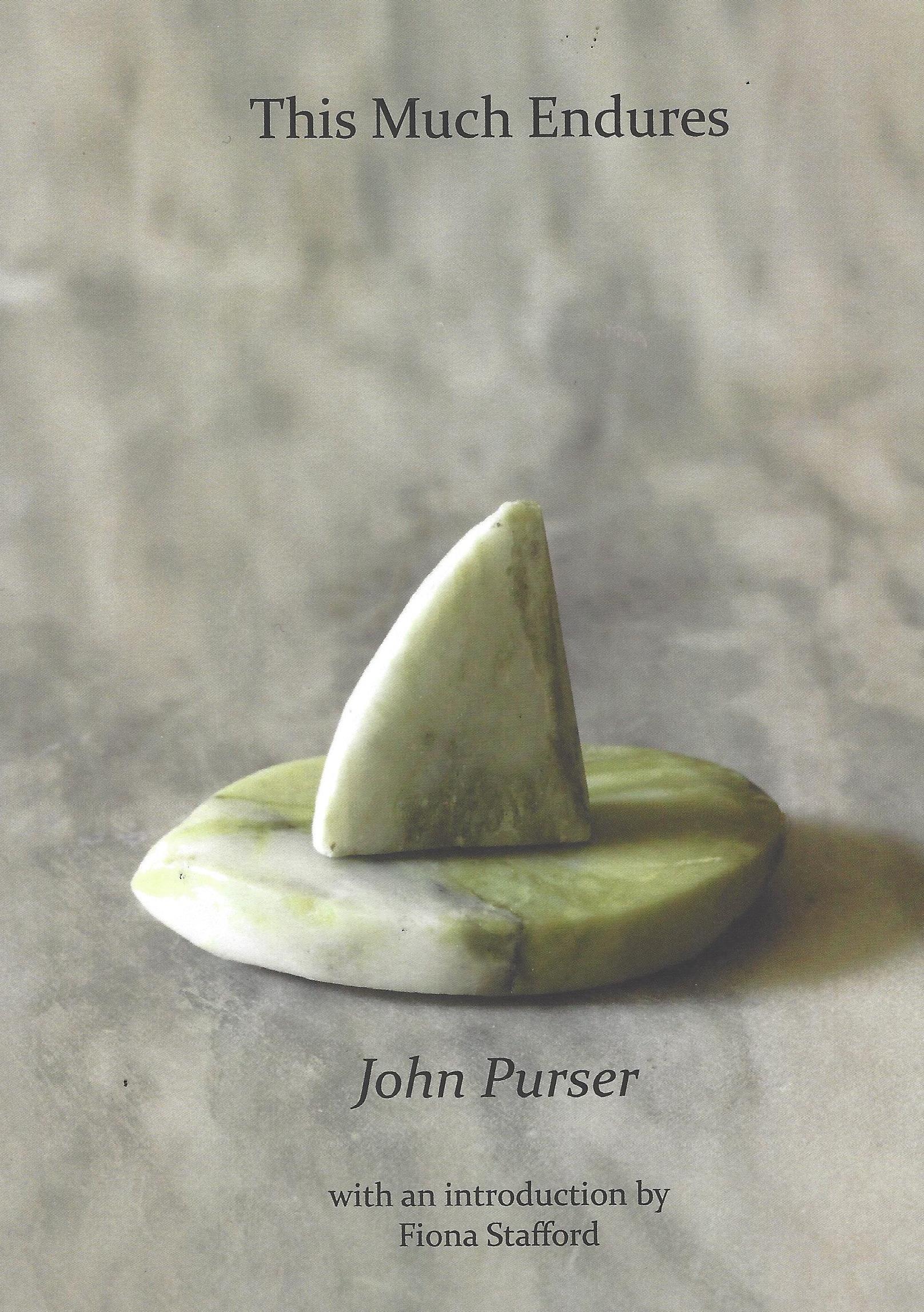
Another contributor to Issue 12, with a poem in Gaelic, addressed to Rody Gorman, was the polymathic wonder – composer, scholar, poet, Hebridean crofter – John Purser. He has just published a collection of poems (with Kennedy & Boyd, Edinburgh), poems as expressive of their author’s soon-to-be octogenarian joie-de-vivre and generosity spirit as anyone could wish for.

The book’s title This Much Endures derives from a poem in the series of Amoretti, poems of love and celebration, quite un-Spenserian in kind, the most characteristically witty and sharply observed of which, for my money, is no. XXVI ‘Birthday Suit’. There are a good many dedicatory poems here, celebrating friendship, one to our very own Archipelago mainstay, Alan Riach. Fiona Stafford provides an introduction to the book, as perceptive as it is warm-hearted towards this most remarkable human being.

Readers should also pursue Purser’s CD Dreaming of Islands, with its settings of work by Sorley MacLean and by Iain Crichton Smith, and other compositions based on songs from the pìobaireachd tradition. Purser is staggeringly accomplished in many musical forms of making and performance, and a great scholar of the Celtic world too, as may be discovered most readily in his online collaboration with Meg Bateman: Window to the West: Culture and Environment in the Scottish Gàidhealtachd, a veritable treasure trove for the archipelagically minded.
Posted on

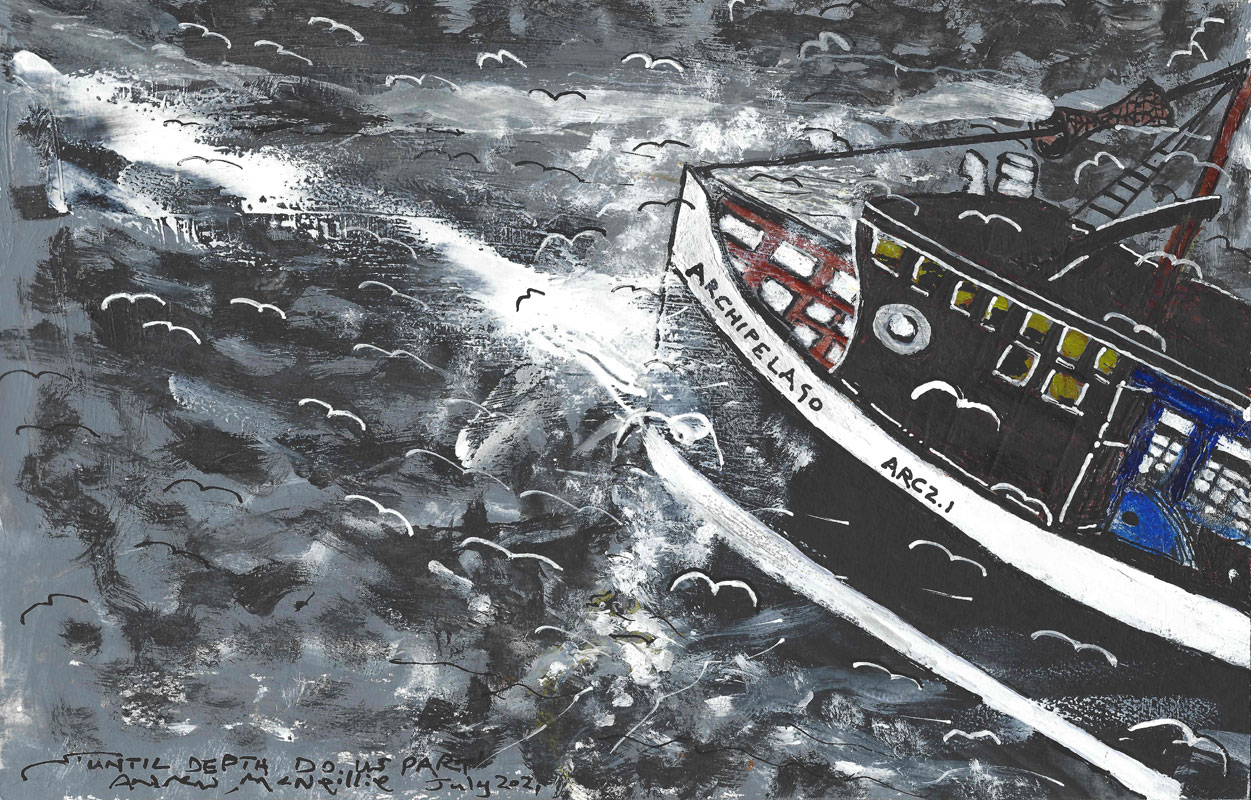
Until Depth Do Us Part

The Harbour Light

. . . . . . . . . . . .  lowered and lifted –
a canary in a mine-shaft fluttering
guttering but unquenched. Lead kindly
as she wrangles and haggles for passage
through wheeling collisions of light
flashed at death’s threshold, hell’s mouth,
heaven’s gaping gate, the narrow strait
and close scrape, Davy’s Locker and lamp
together, rocky seamark and landmark
vying on a soul’s darkest before the dawn,
gull and gale crying until depth do us part –
glass-eyed cod, haddock, monk, on ice –
the crew, lids propped, dying to turn in,
to drown in sleep until they wake
restless to put out again as much for
the sake of it as for pay’s lean packet.


Weather permitting … and restrictions of every conceivable kind allowing, we’re pleased to tell you we should at last glimpse the Harbour Light in time to bring our catch to market early in the new year. You will allow us, I know, a certain poetic licence in our promises. Just as I know you’ll be happy to hear Davey also, where you read Davy. It’s the nature of the undertaking, and makes sound sense. As to the ‘pay’s lean packet’, it would help the cause if you could place a pre-publication order for Archipelago 2:1, earlier rather than later in the day, through the website. We’ve been lying low for the past couple of years, dependant on income from our diminutive backlist, and our funds are at a low ebb. Do please help boost them by placing an order. It will make all the difference to our efforts and ultimately your pleasure.

Ireland’s leading independent publisher, the Lilliput Press’s Archipelago: A Reader edited by Nicholas Allen and Fiona Stafford is due for publication very shortly. At 578 pages, with a valuable amount of new material, it is a must-buy publication. You can purchase it via the Lilliput website. There you will read Robert Macfarlane’s inspiring endorsement:

Archipelago met and extended my own strong sense, nearly fifteen years ago now, that there was a need to turn the compass-rose of some story-telling and art in Britain and Ireland, away from the south and east and towards the north and west; away from the metropolis and towards rural and littoral margins. Much about McNeillie’s vision for Archipelago appealed to me and to others: its commitment to a paper-only existence; its recognition that no landscape (or seascape) speaks only in one voice — and the hospitality its pages therefore offered to Welsh, Irish and Gaelic-language work; and its wish to bring artists together with writers, and even musicians, to celebrate and commemorate the human and natural cultures of, especially, the Atlantic coasts. It formed an important twist in the braid of what has become known as ‘new nature writing’ in Britain and beyond, it lit up a tradition of coastal place-culture that goes back as far as early Celtic Christian poetry, and I feel fortunate to have been part of its journey.

All the more reason to sign up for the new series. It promises an extended geographical range and more environmentally determined focus while remaining none the less true to its original ground in the unnameable archipelago of Britain and Ireland.

Now the legendary figure of the Skipper is tugging impatiently at my sleeve ‘restless to put out again’, so I say farewell for now, and be sure to fare well.

Posted on

After Tim Robinson’s Time in Space

i.m. Máiréad

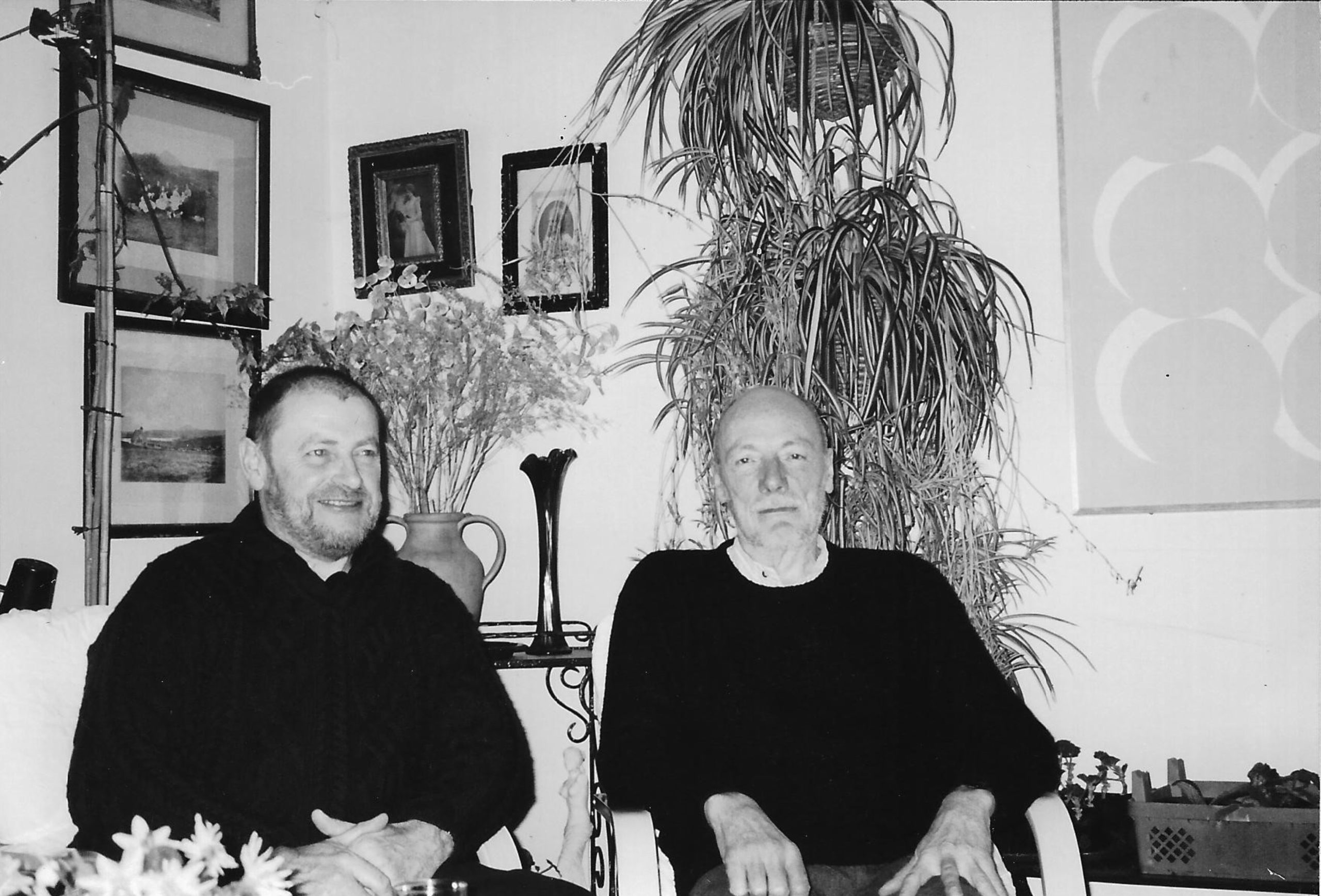
Andrew McNeillie and Tim Robinson at Roundstone, March 2001

After the obituaries, the éloges and sail-shaped remembrances.
After the crowds have left on the boat
and the pollution of their footfall dies away with the evening.
After autumn’s equinox begins the purer dream of winter –
that’s when to settle in to work and when I’ve thought of you
most often, in the capital of monochrome, at Fearann an Choirce,
in your storm-walled house with its empty window-frame,
overlooking the west. And after all now, I find myself
thinking of you all the time – bald, and silent as a Buddha
as you’ve become, staring from a photo on my wall,
from the night we first met, as we’ll never meet again,
to enjoy our squawks, in honour of the sgarbh and the Rock.
The last wise man gone, another ghost in the ranks up there,
gathered with Thoreau and Melville, to watch below
worst fears for Earth and humankind come true,
in our wireless shapeless world, bound by the heptagonal sea,
as the covid strikes us down, as, bitter irony of ironies,
it struck you; and puts us in our place as we deserve,
to rethink our time in space, and dwell on who knows what to come?

Andrew McNeillie

Tim was a visionary genius and an unacknowledged legislator in the making of ARCHIPELAGO, in which he appeared only three times. His commitments to completing the Connemara Trilogy were too compelling for him to think about anything else. When he was done with that enormous labour he was tired of topographical writing and wanted to write more experimentally, somewhat in the spirit of his book My Time in Space. See ‘The Seanachaí and the Database’(Archipelago 7),’The Gods of the Neale’ (Archipelago 9), ‘The Centre of Gravity’ (Archipelago 10).

Tim died of the Covid 19 virus. He had been suffering from Parkinson’s disease for quite a while. His wife, inspiration and collaborator Máiréiad had died two weeks before. She too had been seriously unwell for some time. When I say her name I have one memory of her that always springs to mind at once. I’d been visiting them in Roundstone, and after breakfast, on a sunny morning, walked with Máiréiad in the sea-garden there. The waves lapped on the rocks just a short step away, the sun sparkling in them. She told me about her current reading. Her studies in Greek were another intense preoccupation. She was a most voracious reader, and a serious self-schooled language student, fluent in a number of languages, including of course Irish. Suddenly she started speaking in Greek. It is a most extraordinary noise to hear anywhere, but by the sea, with many small islands nearby, it seems preternatural. Or so it did that morning. I didn’t know it until she was done, but she was declaiming the opening to the Oresteian trilogy of Aeschylus. It felt like an epiphany of some kind, something out of this world. Now they are both out of this world and it is the greatest personal loss and to our community.

Posted on

Number 13

Since Archipelago 12 sailed into the world, we’ve all been stood down, though the wheelhouse is still spinning in its wake and beside itself. I gave the Tannahill Lecture at Glasgow University in February: ‘Theatres in the Round’, about islands, from Inis Mór to Whalsay, and their lives, in print, in image, and in themselves. The lecture was subsequently edited into five parts and published in the culture pages of the Scottish daily the National – a fine institution, very much of the times, proud to be dismissed by the quisling Michael Gove as ‘The worst newspaper in the world.’ Meanwhile Brexit glooms over Scotland

the latest cauchemar out of England.
Send it home to think again:
Enlightened Scotland must Remain,
by auld alliance, European . . .

as our resident ballad singer puts it.

‘Creach is iomairt’ – foray and turmoil – from Seeker Reaper by George Campbell Hay.


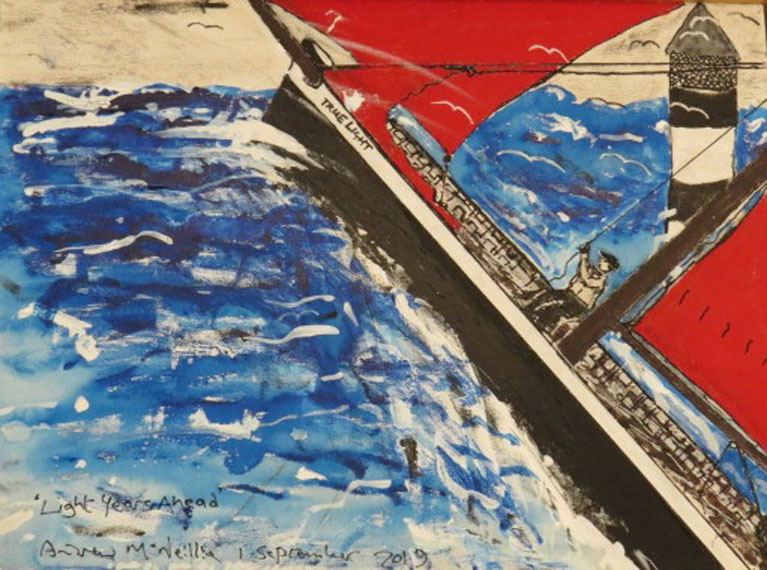
‘Light Years Ahead’ Richard Murphy’s True Light about to leave the planet.

And I was in Dublin for a discussion on Richard Murphy at Trinity College and helping launch Ben Keatinge’s collection Making Integral: Critical Essays on Richard Murphy published by Cork University Press, an essential purchase for anyone devoted to Murphy’s lore.

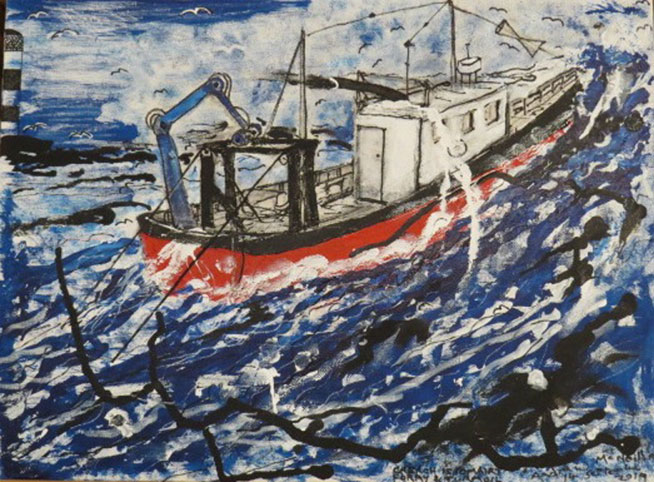
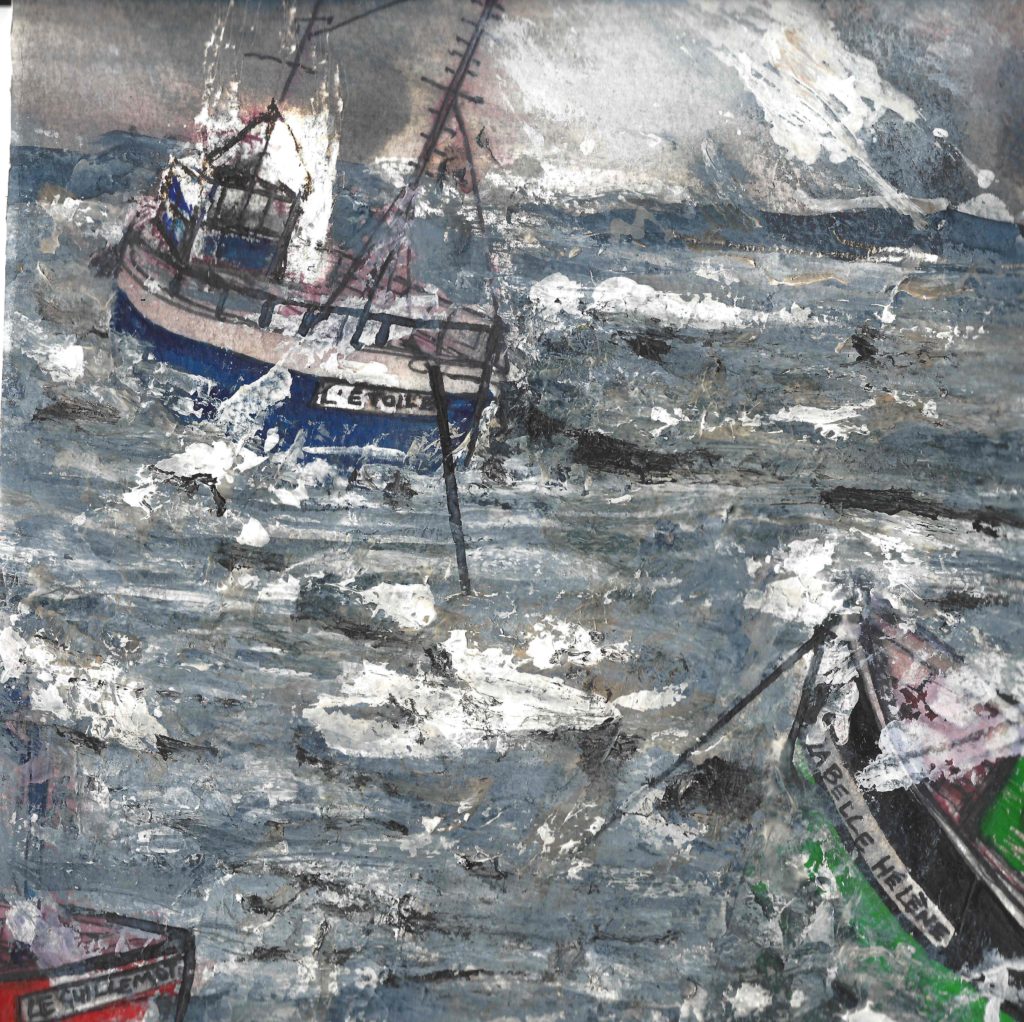
It would all have been marvellous if the number 13 hadn’t kept on flashing before my eyes, like a neon tube on the blink. A symptom even a few days on Inis Mór in October couldn’t banish. As you see, for therapy, I’ve been indulging in some daubing with my painting and decorating kit. Who knows where, when or how it will all end.

Otherwise, I write to remind you that Crexmas is coming and the Corncrake’s getting fat. Time to solve some gift headaches while stocks last.


Posted on

Night-Snow

Night-Snow

wee song for Sydney Graham

The real poem never ends.
The blizzard beneath its last footprint
is where we search in its memory,
the blizzard that is also night
as fresh on your face as snow.

Night-snow the ultimate
a body must weather, body I say,
but I mean soul
out on the manhole sea
where the littoral-minded sail

beyond Cape Metaphor to be.
And Sydney Coastguard keeps his watch
ticking on course for Greenock,
with Alfred Wallis at the wheel
aboard the good wreck Alba.

For who but a blind one can’t see
Scotland from Cornwall? –
every small hour of the year
with the heart in the right direction
and a glass to his eye.


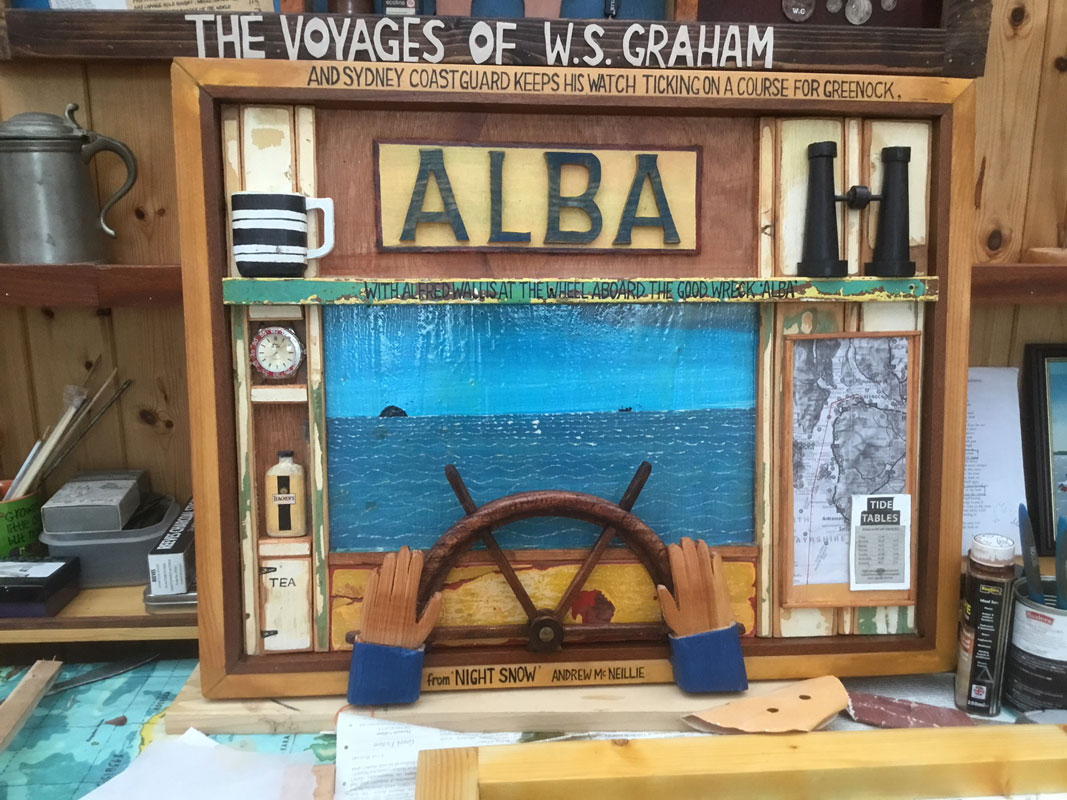
In 2008 the above poem appeared in the Scottish Review of Books. Ten years on it was anthologised in The Caught Habits of Language : An Entertainment for W. S. Graham for Him Having Reached One Hundred edited by Rachael Boast and company. As if all that weren’t honour enough for it, the other day I received the image below from Mike McDonnell, a retired medical man originally from Greenock, now living in the Shetlands, asking my permission to make some use of the poem in the artwork below.


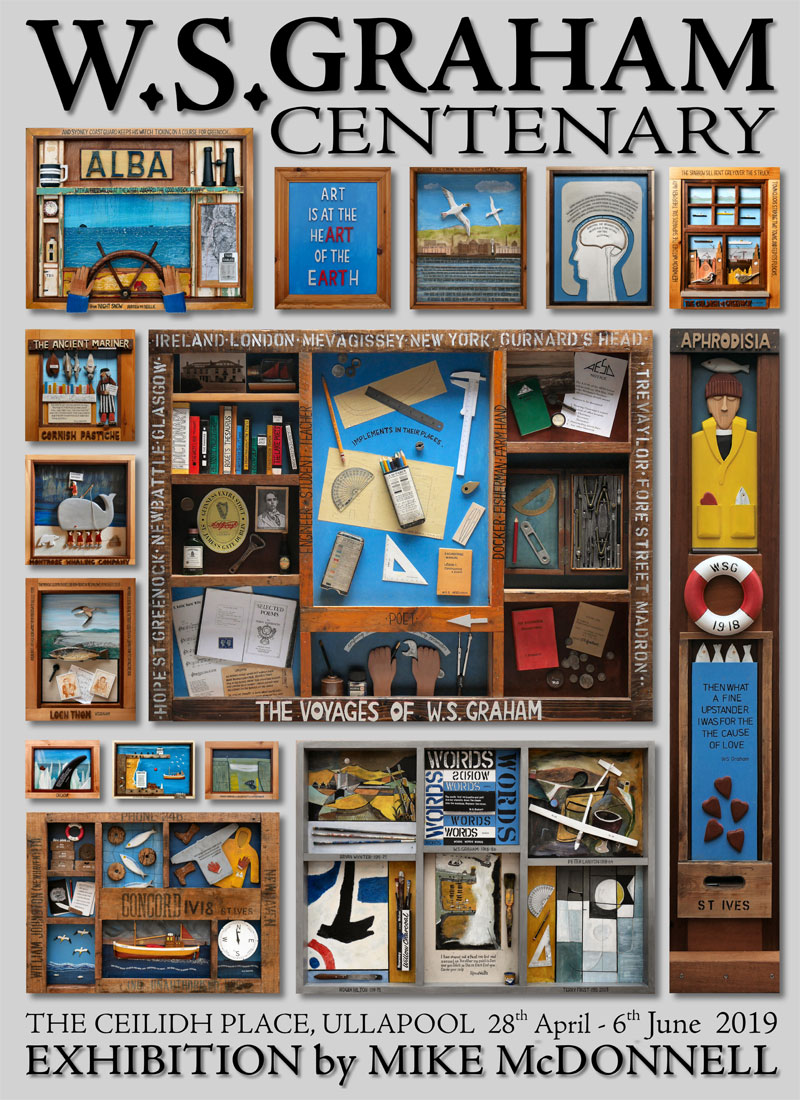
This image is part of an extraordinary series, soon to form an exhibition, as advertised in the poster here. It is just the kind of occasion Archipelago readers are likely to enjoy. I hope to be able to make it to the opening night. See you there . . .


Posted on

Richard Murphy

Richard Murphy was not just a friend of Archipelago and of the Clutag Press. Through his first collection of poems Sailing to an Island (1963), he was a key figure in the history of the entire venture, a founding father in what we might call the archipelagic turn, taken so notably also by Norman Ackroyd and by Tim and Mairead Robinson. Andrew McNeillie’s An Aran Keening (2001), given him by Bernard and Heather O’Donoghue, was he wrote in June 2016 ‘the last prose work I have read from cover to cover with joy all the way’ and on its author’s birthday 12 August that year ‘What a good decision you made at the age of 22, it seems to me, to “chuck up everything and just clear off” – not to Woodstock but to Inishmore for a wild cold winter, and to have the discipline to keep notes from which later to produce a book composed like poetry with style, clarity and wit.’ To say he knew how to be kind is a massive understatement. He was a most delightful and generous-spirited man to have dealings with. In return I wrote the poem here. At his bidding it is to appear as the epigraph to a collection of essays about his work, Making Integral edited by Ben Keatinge and forthcoming – now sadly too late for its subject to hold it in his hand – from Cork University Press. (It recently appeared in Making Ends Meet, published by Guillemot Press.) The day of his death is surely a dark cold day, and hard indeed to think of him crossing the Sound for the last time to the High Island where there is absolutely no email or mobile phone connection, I’m told.


Richard Murphy

Between our roads, a handful of years,
and then the past all round these shores
haunted by the ghost of the Ave Maria
telling the epic of the Cleggan Disaster
holding today up to yesterday’s mirror –
the world kept afloat by running repairs.

The landlady of Oliver’s Seafood Bar
calls in mirth (from a tale or song of long ago?)
‘Your heart beats when you hear my name,’
she laughs and tells it him again, ‘Joe, Joe,
your heart beats when you hear my name.’
So Cleggan resounds, the day set fair

waiting for the ferry. And my head full
of memories of sailing to an island –
of corncrakes in the month of June
grinding out their tuneless tune:
such unlikely music. My heart unmanned
to hear it once more, to hear it still

on Inishbofin by Cromwell’s fort
and the blind tower, as the ferry departs
and leaves me caught in ’68 and ’69 again,
days on the cusp of violence as they were,
reminded of all those broken hearts
from ‘Droit de Seigneur’ to Aughrim –

holding yesterday up to today’s mirror
and reading in its guilt-edged frame
the old story of a poet’s prescience
who saw tomorrow the day before.
Small wonder then that I should say:
my heart beats when I hear his name.

Posted on

The Last Voyage

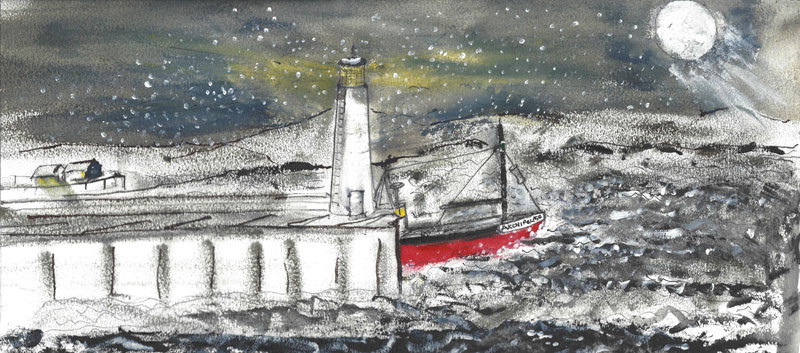
‘Winter Tide: The Last Voyage’  Andrew McNeillie © 2017

If you’ve ever wondered what all this is about, track down Jos Smith’s essay ‘Fugitive Allegiances. The Good Ship Archipelago and the Atlantic Edge’ in Coastal Works (OUP, 2017) edited by Nicholas Allen, Nick Groom, and Jos Smith himself. It gives the richest and most inspired and inspiring account of the project and its origins you could wish for.

Rarely would that same good ship put in at Cill Rónáin, Inis Mór, in August, at the height of the tourist season. But it did this time. And it rained Biblically for three and a half days out of five, with one truly fair day in between, as just deserts for such folly. The place was heaving with half-drowned visitors. ‘Go east, young man,’ I advised myself, away from the tourist trail. So I devoted my stay to exploring a part of the island I’ve tended to neglect in the past. Usually I visit out of season and I’m drawn west to my old haunts. (Next year in November, they’ll be old haunts of fifty years ago. I will head there again, to make landfall 3 November, in foul weather, I hope.)

I can’t claim to know the southeast well. But at least I know where to find it. J. M. Synge drew me to it but in a puzzling way. As I always do I took his The Aran Islands with me, in the little pocket-sized World’s Classics edition (Four Plays and The Aran Islands, 1962) that had been my companion during my original sojourn on Inis Mór (1968-69) – together then with The Plays & Poems of J. M. Synge (Methuen, 1963), a school prize I chose and was awarded in 1965. Both are treasured ‘comfort books’ now, layered with personal association, as also in my bag this trip is Richard Murphy’s Sailing to an Island (1963), in the copy I’d bought in my youth, in 1965, at what was Green’s Bookshop on Dublin’s Nassau Street. (I will be back in Dublin on the Murphy trail on 21 September at an event at Poetry Ireland’s HQ in Parnell Square, in celebration of his 90th birthday.)

On the evening of his arrival on the island, having first walked along the high road to the west, Synge had gone out to the east, beyond Cill Éine and Iaráirne ‘to a long neck of sandhills that runs out into the sea towards the south-west’. Of course the extensive dunes lie to the island’s east, at its southern end. Along the road Synge met ‘a boy and a man’ and asked them if there were any trees on the island. They held ‘a hurried consultation in Gaelic’ at the end of which the man asked if by ‘tree’, Synge meant ‘bush’ – if so, the man told him ‘there were a few in sheltered hollows to the east.’ The bushes or trees, such as they were, lay then,  as they do now, to the west, at Cill Mhuirbhigh.

What was Synge thinking? Was he disorientated? I confess to not noticing this glaring curiosity until recently, more or less on the eve of my visit. It’s the kind of thing we often don’t see as we read. As far as I know, and that might well be not far enough, no one has drawn attention to it before. I apologise if I’m telling you what you know already.

I checked through all the editions of The Aran Islands I own, including the OUP Collected Works (vol. II Prose, 1966), back to the 1912 Maunsel Edition (in which I first read it). All give the same misdirection. So was it a mistake by Synge or by his original editor and or printer? It was I believe one or other of the latter, or both, and then perpetuated by subsequent editors, even at OUP. For in his little essay ‘An Impression of Aran’ (Manchester Guardian, 24 January 1905, reprinted in Nicholas Grene’s invaluable J. M. Synge Travelling Ireland. Essays 1898-1908, Lilliput Press, 2009), Synge makes no mistake: the sand-hills run ‘out into the sea towards the south-east’ and the bushes or trees grow in the west. He knew what he was talking about.

This is surely not the place for such a piece of trivial editorial pedantry, but there it is. I’ve got it out of my system. Or how trivial is it? I like a book about a place to know the place it is about. It is an editor’s job to leave no stone unturned. But here were two left unturned for more than a century. I like east to be east and west to be west, old-fashioned as that might be, never the twain to meet.

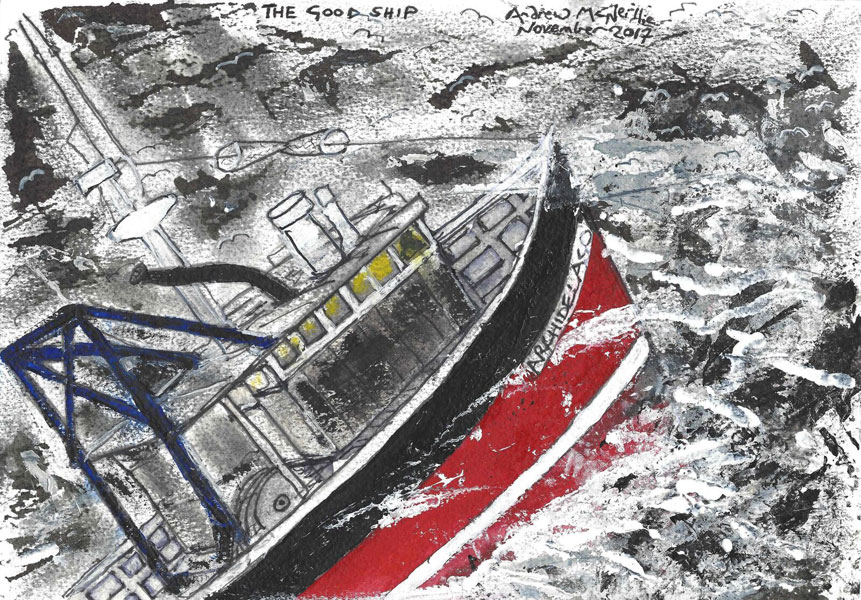
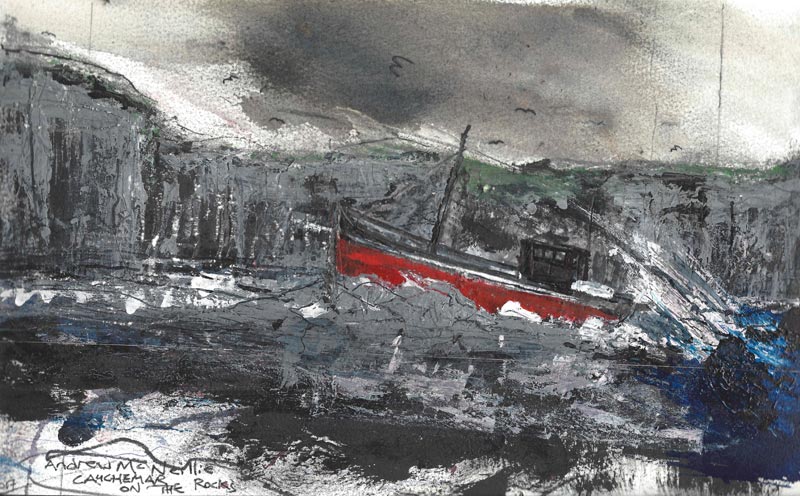
Otherwise I dreamt wildly during my nights on the island, as the image above ‘Winter Tide: The Last Voyage’ suggests – never say worst, never say last? think what became of the Pequod. It’s a vision I had of setting out, slipping harbour in search of Archipelago 12 – which I will do in December, and I hope not end in a ‘Cauchemar on the Rocks’ as portrayed below. Or even worse, adrift with only Queequeg’s coffin (still less my own) to keep me afloat. Though ‘Call me Ishmael,’ has ever been my cry.


‘Cauchemar on the Rocks’      Andrew McNeillie  © 2017


Posted on

Haven

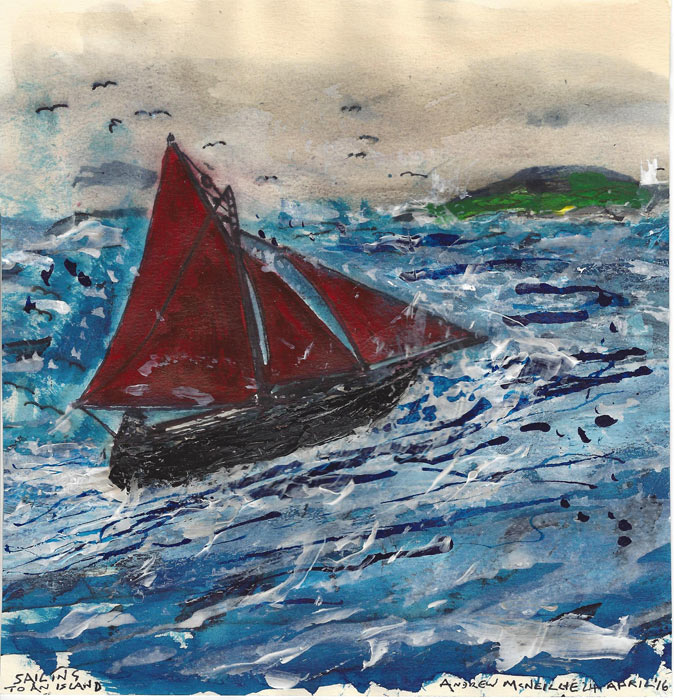
The picture here alludes to a poem by an Irish poet. A free copy of Richard Murphy’s In Search of Poetry to the first and only to the first person to identify the poem. Enter the name of the poet concerned in the subject line of your email to info@clutagpress.com – we’ll publish In Search of Poetry towards the end of April.


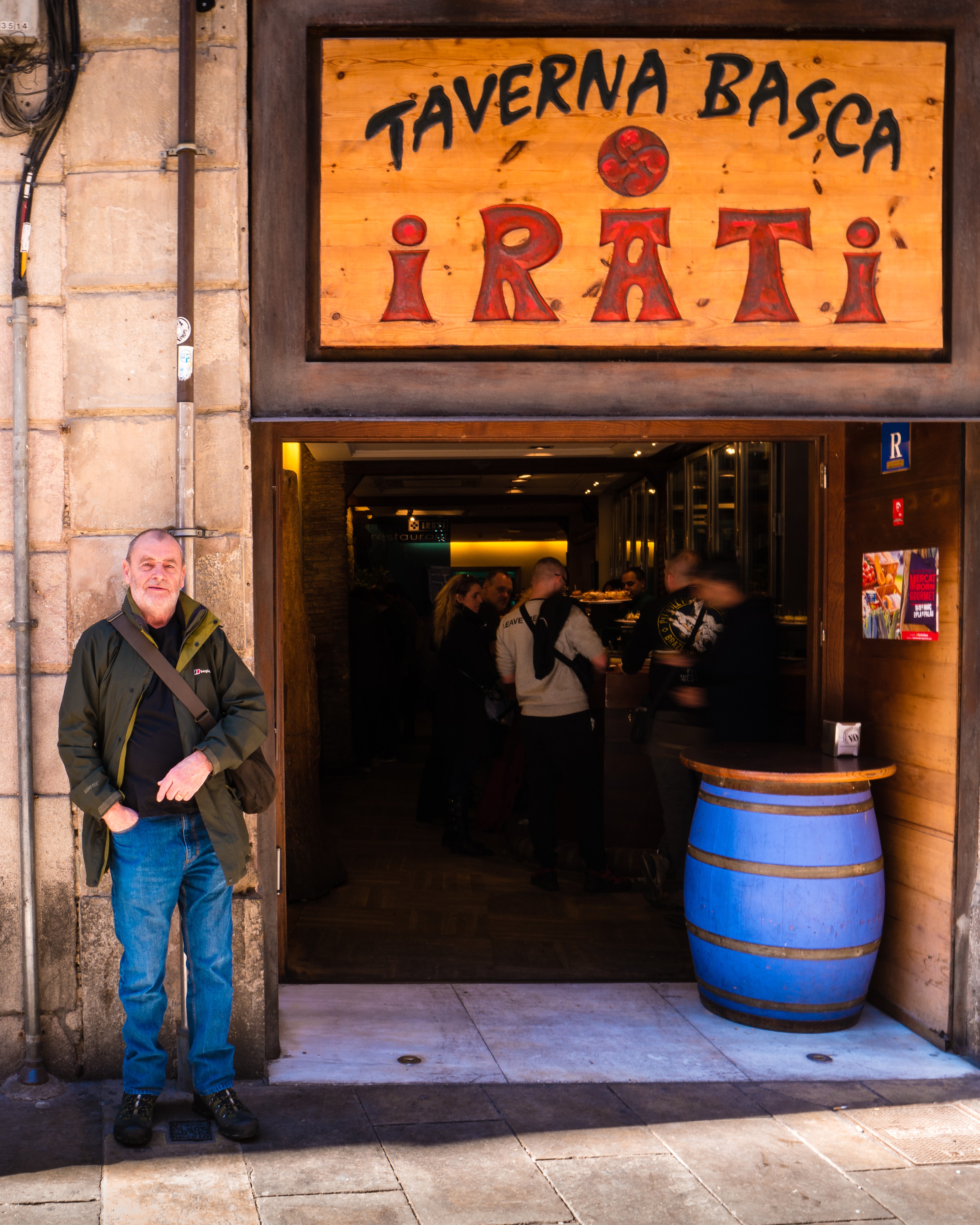
The photograph here, taken by John Sullivan, shows the editor of Archipelago on a recent revisit to Barcelona, outside the Basque Tapas Bar IRATI where the venture was first conceived and aired in a conversation with John, over ten years ago.

Issue 11 of Archipelago is selling well. Issue 12 has been postponed to the end of 2018. That year will also see publication of a volume of essays called DEAD GROUND edited by Andrew McNeillie and James McNeillie, about which we will post full details a little further down the line.

We are especially pleased to announce publication of Patrick McGuinness’s Five Poems – No. 15 in the Clutag Five Poems Series. Please visit the website ‘Shop’ and order your copy.

Posted on

Geoffrey Hill (1932-2016)

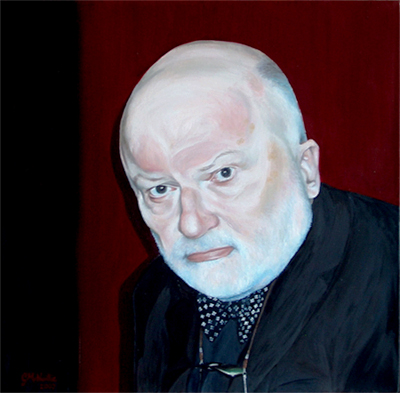
Geoffrey Hill by Gail McNeillie
Oil on Canvas, 2007, 50cm x 50cm
Purchased by Emmanuel College, Cambridge


It was the poet and critic Peter McDonald who introduced us in the end and it began with a phone call. There was a question that Clutag Press might publish a pamphlet of Hill’s current work. Hill was interested I suppose for a number of reasons. He always liked to support a marginal venture. (I’ve been told he lived just long enough to cheer Iceland on in their European Cup victory over England – the English side an example of ‘plutocratic anarchy’ in action if ever there was one.) But why my venture? At hearing my name from Peter he asked, ‘Is that the man who wrote those poems about me in Stand?’ It was. And that, I think, made the difference.

I had published in Stand a sequence of sonnets called ‘Portrait of the Poet as a Young Dog’. Two of them concerned Hill. They derived from an unhappy passage in my life that saw me spend a year at Leeds University where I did no appropriate work, attended few lectures, and almost no tutorials. It is hard to think how I got away with it for as long as I did. I was only interested in trying to write poems. But two things I did do. I attended two courses of  lectures very assiduously, one, a series on aesthetics by Quentin Bell, the other by Hill on poetry from W. B. Yeats to Ted Hughes and Thom Gunn. Hill’s course has become legendary among a subsequent school of Leeds poets, chief among them Jon Glover and Jeffrey Wainwright, graduate students, in my short time there.

So Welsh wilderness-green and wildly shy was I in those days, I wouldn’t say boo to a goose, not even to those two gentle souls. Nothing would have induced me to buttonhole Hill. But I sat in the very front of the lecture theatre and observed him closely. (I could see the beads of sweat on his forehead.) He was I thought wonderfully gloomy, and at times engagingly savage, in his literary criticism (he mauled Thom Gunn with unforgettable brutality), and towards the supposed poetic aspirations of some in his audience. To my mind, fresh out of Wales, he had something of Dylan Thomas about him that surely helped me take to him. I could see (and approve) it very obviously in his early ‘Keble’ sequence ‘Genesis’. He read with a Thomasian sonority and not in the flattened matter-of-fact, uninflected manner of the so-called Movement poets. I have always tended to prefer that.

According to Hill, I caught his likeness at that time, ‘uncannily’ – ‘sweating in his funeral suit of charcoal grey’:


His black shirt, in that artificial light,
caught tenebrous hues, green as Baudelaire
’s dyed hair; his pudgy face so queer,
his brow so damp, as if he spent the night
in hell-on-earth, every day of the year,
and knew he was the only poet there.


It was momentous for me to meet him at last. I did so at Christ Church, Oxford, in Peter McDonald’s rooms. A devoted reader of his work for decades by then, I was awestruck and pretty well tongue-tied before him, no matter he was extremely benign and twinkly-eyed towards me. For his part, Geoffrey could always be difficult to stir into conversation, at the best of times. Though once launched he was invariably magnificent and often Hill-arious. I can’t remember a word that was said on that first occasion but arrangements were made. There would be a publication, a pamphlet. Peter McDonald oversaw an arrangement with the Christopher Tower Trust whereby funds were to be used to further poetry’s cause. So for the first and only time Clutag received a significant grant which comfortably enabled several pamphlet publications including what became Hill’s A Treatise of Civil Power (2005).

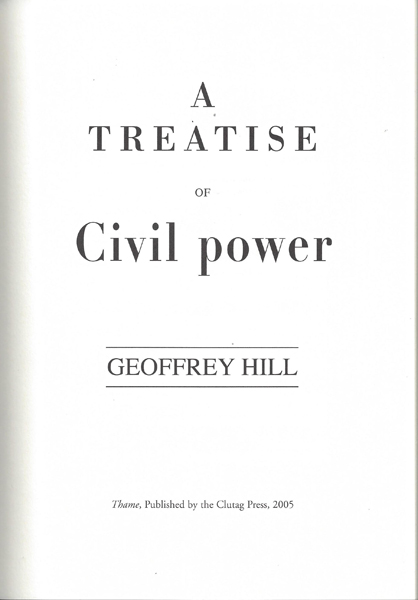
This was perhaps in spring of 2004. I was working at Oxford University Press by then. On 29 September that year I received an email from Ken Haynes (Geoffrey’s close friend, amanuensis and editor) with seven attachments. Six poems and a mock-up of the title page, giving the precise typography and design required, to approximate to, but not to reproduce as facsimile, Milton’s pamphlet of the same name, down to the place of publication:

Treatise-title-page

The poems were set and proofs made ready. But progress was delayed by the addition first of one poem and then another. These were sent in a most apologetic manner. I was at liberty to turn them down. I wasn’t so foolish and what began as a pamphlet expanded, not unalarmingly, in terms of binding, into what Geoffrey called a ‘booklet’. It was a brilliant new start for Clutag Press which up to that point had trafficked only in small two-page leaflets, hand-set on an Arab printing press. (I should say that the version of the title poem in the booklet’s pages is to be found nowhere else and is in my view far superior to the one subsequently published in the book of the same name.)

As you will know from the website Clutag Press went on to publish two books by Geoffrey Hill and to issue a CD of a reading he gave in Oxford’s Sheldonian Theatre. I would sign up his critical writings for OUP, and also his collected poems. In that time I got to see Geoffrey regularly, in Boston, Oxford, and latterly in Cambridge, and enjoyed his great warmth, extraordinary kindness, and personal concern (for my and my family’s well-being). He was deeply proud to be a copper’s son from Bromsgrove and that was a starting place at which it was most comfortable, and often most illuminating, to meet him. He was an intellectual giant but the artist in him held a simple ground too. I saw this very clearly once when, on the morning after his Sheldonian reading, 2 February 2006, I drove him to Kidderminster where his wife Alice Goodman was then living, serving as an Anglican chaplain there.

I slowly realised as we travelled farther and farther from Oxford and nearer and nearer our destination that we were on a nostalgia journey, into the realms of Goldengrove, into Offa’s territory, and the nearer it we got so he became more and more animated. He seemed to radiate sensual pleasure. At one point, as we passed on the other side of the road, a great black steam engine on the back of a low-loader, I thought Geoffrey was going to jump through the roof of the car at the sight of it. He was like a child in his excitement. Here was the past made manifest, here was childhood, here was the Eden of the West Midlands in transit, here was memory redeemed in the moment. We had to take particular roads. I had especially to see the sand quarry in which the young Offa – after flaying Ceolred – ‘journeyed for hours, calm and alone, in his private derelict sandlorry named Albion’. This was the territory of ‘The Jumping Boy’, who is celebrated so marvellously in Without Title (2006), then newly published.

I have far too much to relate about him than is appropriate here and now. The fact of his death – though I had heard he was ill – came as such facts do as a shock of numbing force. He was a literary giant, a staggeringly learned man. That I of all people should ever have known him and been numbered among his friends still seems as incredible to me as it would have done to my youthful, delinquent self at Leeds in 1965.


3rd July 2016

Posted on

Sailing to an Island

A week ago at the time of writing this, I had an email from Philip Marsden, one of our prized Archipelago contributors. He told me: ‘I leave for Dingle at dawn on Friday’. It was the stirring opening to a poem, for sure, the ring of Auden’s ‘Leave for Cape Wrath tonight’ about it, though none of the period desperation. By now he’ll have that first leg of his single-handed voyage from Falmouth to the Hebrides behind him. We hope to rendezvous up there somewhere weather and time permitting. But whether we can or cannot, he will have had the better part of it by many a sea-mile. I can only imagine what poignant and vigorous wonders there’ll be in his log.

Just as I heard from him I was sorting out a trip of my own, to take part in the Inishbofin ‘Island Conversations‘ Festival (2-6 June 2016), an event organized by Peadar King. I believe I’ll be there in the company of Norman Ackroyd, Michael Longley, Bernard O’Donoghue (all long-term supporters of Archipelago) and a host of others, and I thought it the moment to give you advance notice, to encourage you to book your place and support this vital fledgling project.

Inishbofin is of course indelibly associated with the Irish poet Richard Murphy and above all his landmark-seamark volume Sailing to an Island (1963). Murphy is the unacknowledged legislator behind the Archipelago venture, which itself first surfaced in November 1968, at Cill Rónáin harbour, Árainn – long-ago now when the fishing, while not what it once was, was far better than it is now in the threadbare seas of today.

Dancing Days for Fishing

She holds nothing steady on land or sea today.
But what-ho! proclaims, What-ho! her name.
Her compass needle dances a delicate ballet
pirouetting en pointe. ‘Where, where, where …’
the gowned waves chorus.

Gulls in mobs clamour in the gods.
The mountains pitch and roll
like whales breaching among clouds
and the island at its mooring
spouts and spouts again all morning.

She parts the seas, thumbing through
for half-remembered lines,
myopic as late mackerel blinded by the light –
as jigging in mid-air they used to come
when time could count itself so lucky

that it could catch a hand and a tilly hand …
that it could see so many all at once
to string through the gills
a youth’s share, as nevermore
to hang on a handlebar for an encore.

Andrew McNeillie


If you do not know Murphy’s work – shame on you, until you obtain his collected poems from Antony Farrell at the Lilliput Press (which includes some notes on the poems by the poet, and a piece by Bernard O’Donoghue on ‘Pat Cloherty’s Version of The Maisie‘).

I’m counting on seeing you on Cleggan quay, waiting for the ferry. Don’t let me down, now, and remember, carpe diem:

I wait on the quay
And the quay waits.
There’s many a thing more lasting than person
I hear it say
At no great length.


9th May 2016