Posted on

High Summer

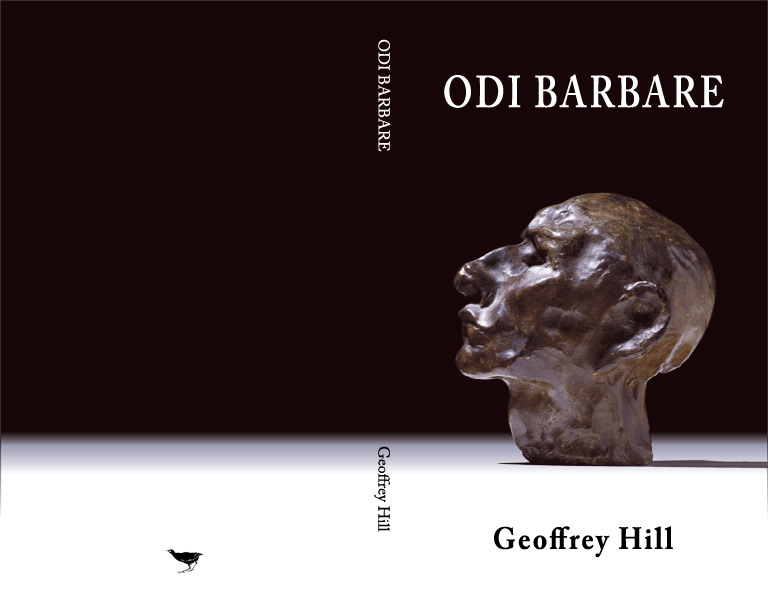
Geoffrey Hill’s Odi Barbare (see elsewhere on this site) has been shortlisted for the Forward Prize. We send Professor Hill our congratulations and urge readers to order a copy of the book while stocks last. It will not be reprinted.

Archipelago 7 is almost all delivered. We have had to postpone at least two pieces to issue 8 having otherwise exceeded our optimum extent. That is, along the lines of the last three issues. Among the contributors: Tim Dee, John Elder, Seamus Heaney, Roger Hutchinson, James Macdonald Lockhart, Michael Longley, Angus Martin, Sandy Moffat, Les Murray, Katherine Rundell, Robin Robertson, Tim Robinson, and other treats and surprises. Among locations touched on: Kintyre, Raasay, Giant’s Causeway, Rathlin, Connemara, Co. Clare, Vermont, Coventry, London.

We regret to announce that we have been forced to raise our price for the magazine to £12.50 (UK & Ireland) £17.50 (North America & Row). This deeply regrettable measure is made to help us cope with recently hiked postal rates. Subscriptions paid prior to this announcement will not be affected.

We will notify subscribers as soon as the new issue is in the offing – by or in early November. Meanwhile, some recommended reading: Kirsty Gunn The Big Music, Kathleen Jamie Sightlines, Robert Macfarlane The Old Ways, and Ian Hamilton Finlay: Selections edited and introduced by Alec Finlay.

16th July 2012


Posted on

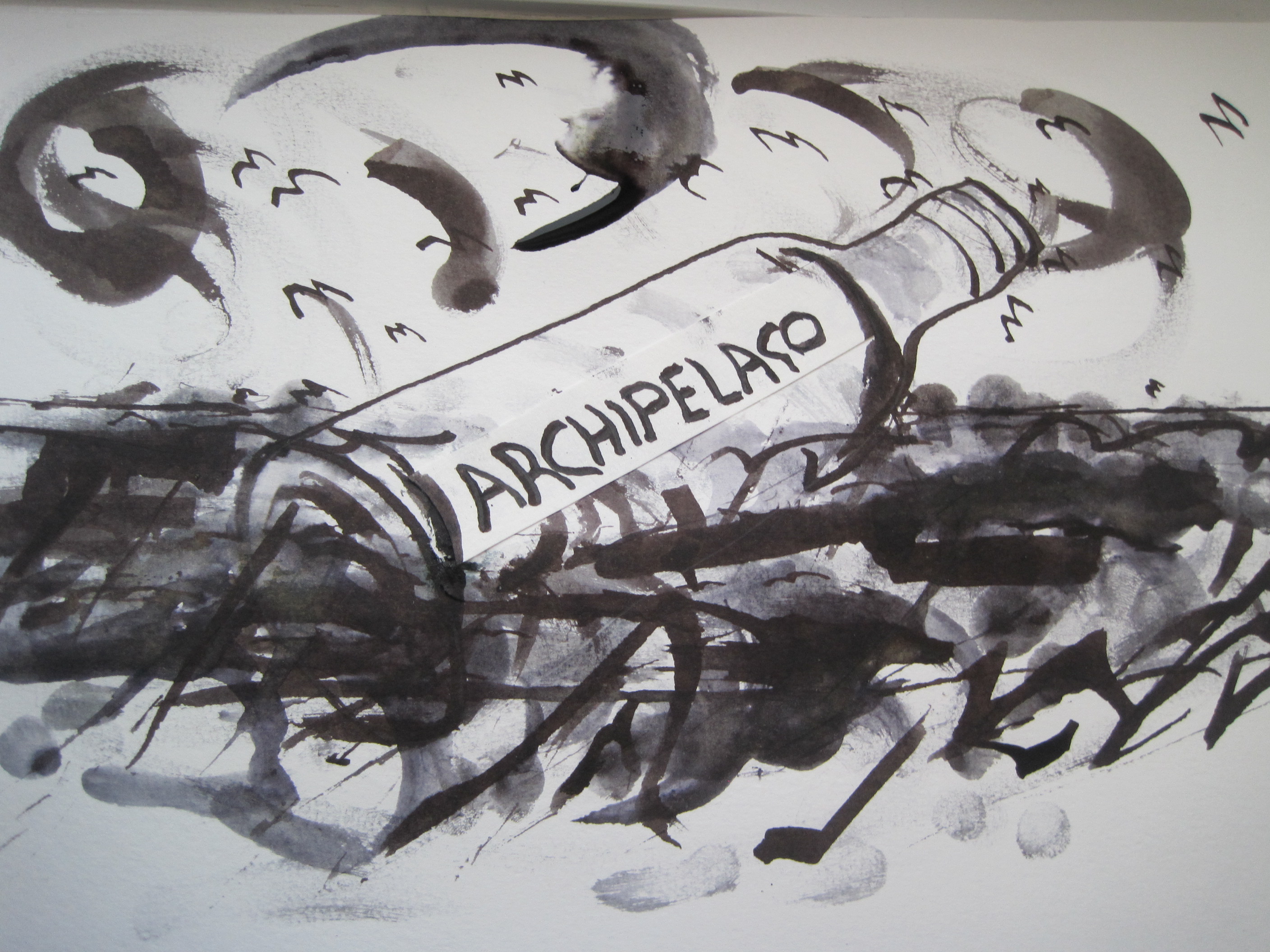
Message in a Bottle


26 April 2012, Newman House, St Stephen’s Green: ‘Over the Irish Sea’ symposium hosted by University College Dublin – Jos Smith of Exeter University gives a talk about Archipelago, its preoccupations, its contributors, and the idea of ‘critical localism’ as a radical stay against globalism. It is inspiring to have the project of the ‘unnameable archipelago’ given serious attention at such an occasion and among so many high-powered scholars. Otherwise, of course, I try not to be too serious. I have bought a first edition of Tom O’Flaherty’s Aran Men All (1934) of which I’ve only read an excerpt before.


2 May 2012: I’m writing this beside the Atlantic at Port Bhéal an Dúin (Port of the Fort’s Mouth) near Gort na gCappall (Meadow of the Horses) the only village on the south shore of Árainn, one sometimes referred to by the islanders as ‘West Cork’. It is a hot day and after several in which the wind has most unusually sat in the east to north-east without let-up or shift beyond a point or two of the compass. Such sustained steadiness leaves the Atlantic shore relatively quiet. From Bothar na gCreag by which I came, I could see not just the cliffs of Moher but also the Brandon Mountains much farther south. There have been showers and last night it pelted and blustered. I have been here with Tim Robinson. He left yesterday. We walked together for hours, from shortly after our arrival on Sunday 29 April by the 1pm ferry from Ros an Mhíl in Connemara. It was his first return for eight years, he thought, possibly more. I’m not sure it isn’t a little longer, for he had not seen the harbour works, now just about completed. They have transformed Cill Rónain, the island’s capital. They represent Celtic Tiger money well spent and now to be had no more. I have been coming back since 1999, once or – more often than not – twice a year. Apart from the harbour and the fuel and waste disposal depot on the Low Road, nothing has altered that much. Cill Rónain’s bars and immediate accommodations proclaim themselves more garishly than they used to. An anxiety that the new reservoir had drained An Turlach Mór dry once and for all proved unfounded. It is one of the richest and most bio-diverse sites on the island. There has just been very little rain. It doesn’t alter the fact that depot and reservoir might easily have been camouflaged to blend more discreetly into the landscape. ‘Don’t mention the buses, don’t mention the bicycles,’ one of the jarveys urged us. For my part, I won’t. For me the wonder of walking the island with the author of Stones of Aran was too great to bother with anything else, except perhaps the crowing of pheasants where once one might have heard in early May the corncrake. (We heard and saw cuckoos, as of old.) There are pheasants all over the island, madly introduced, I don’t know by whom, in the past ten years or so. Talk about aural pollution, they seem to mock the place. With each call I hear English rural evenings, round about a great estate, summoning up the shades of landowners whose forebears had a stake in oppressingIreland. As he should be, Tim is held in the deepest affection by the islanders, not least for his knowledge of the Irish language. ‘You search in Árainn for Árainn? O Traveller! / in Árainn itself, there is no room for Árainn’ – is not quite true, but certainly not in the company of Tim Robinson. He knows more about the island than all the islanders put together. Our walks by favourite routes to special venues were like living tutorials in place-lore and I will never forget the botanising, especially, in pursuit of elusive species – Limestone Bugle and Pyramidal Bugle which we could not find, because they flower in March and as they die down are all but impossible to trace. On the way to Dún Dúcathair we chewed on sea-spinach – as hot and peppery as water-cress, it leaves you  feeling as if you’ve had a full meal – and rock samphire too. But I will write about all this elsewhere, another time.

Tom O’Flaherty has also kept me company. He quotes an old island saying: ‘Is ío ma ní is buáine ná an duine’  – ‘There’s many a thing more lasting than a person’. He is a superb writer, no less than his brother Liam. I see that the O’Flaherty home in Gort na gCappall is currently up for sale, no price given. It ought to be bought for the Irish nation. There is a magnificent memorial to Liam O’Flaherty just across the road from it, so perhaps civil Árainn should rise to the occasion again. 

14th May 2012

Posted on

Memories Are Made Of Fish

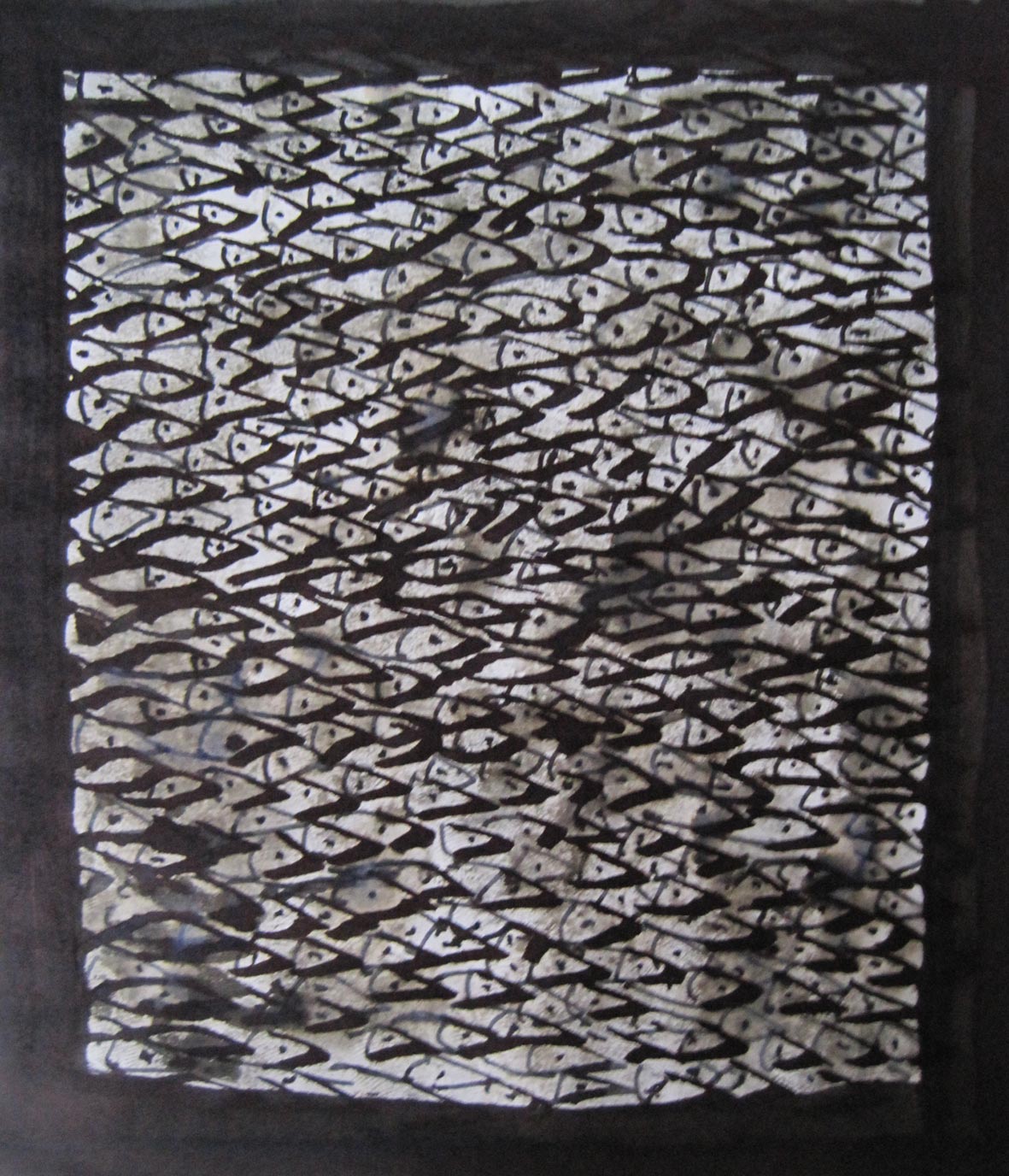
With Geoffrey Hill’s latest book of poems in the world at last, I’ve been mending my nets these past few days and had a few prospective shots, for target catches around Barra, the Isle of Lewis, Raasay, Ornsay, Kintyre, on south to Rathlin, then down the Irish Sea and round as far as the Llwchwr Estuary, on the North Gower coast. Things bode well to make the new issue different once again, come November’s high seas, with startling new art and other illustrations too. I’ve left some fixed gear out there off Connemara and in the wider Atlantic, with my eye on a couple of catches, but mum’s the word. I’m using monofilament and I’m not after You-know-who (pace Monsieur Coldiron) but big fish nonetheless. Already I hear among the crew some Scots and some Scottish Gaelic; a little Welsh too, but sprats not mackerel, or shellfish rather; and the raucous gull-cries of English city folk (riotously conspicuous consumers) in the urban wilderness or ‘bewilderness’ as I think we should call it. The metropolitan promises well this time, as never before. But I mustn’t show my hand so early and there’s many a slip. I must heed the old man’s advice: ‘Never let the next man ken ye, but haud yer tongue…’ When time comes for the last haul, I will need to slip from harbour before dawn, perhaps in foul weather, so none might see where I’m bound, and come back late, to keep close how many stone I netted on my way – what species of catch I made; what writers, artists and poets I had for crew at the last, until it’s time to publish Archipelago 7 and be damned in the arc-light glare of the dawn fish-market. Truth is these are hard times everywhere and we’re scraping the bottom at present. Even the barnacles are complaining. It’ll be a while before liquidity floats us on its spring tide, but given time it will, and all manner of thing shall be well. Meanwhile I work away, early and late, whistling and humming to myself that old crooner’s standard: ‘Memories are made of fish …’

CAUGHT-BY-THE-RIVER and NEW NETWORKS FOR NATURE – These enterprises continue to be our favourite fellow-travellers. Please enquire after them and support them however you can.

28th March 2012

Posted on

Against the backdrop of a stormy sky. . . .

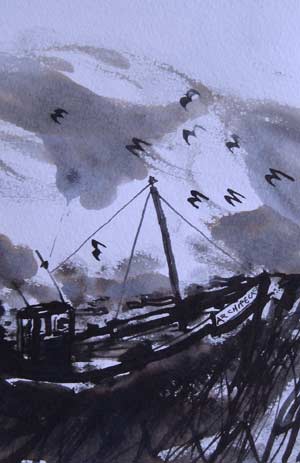
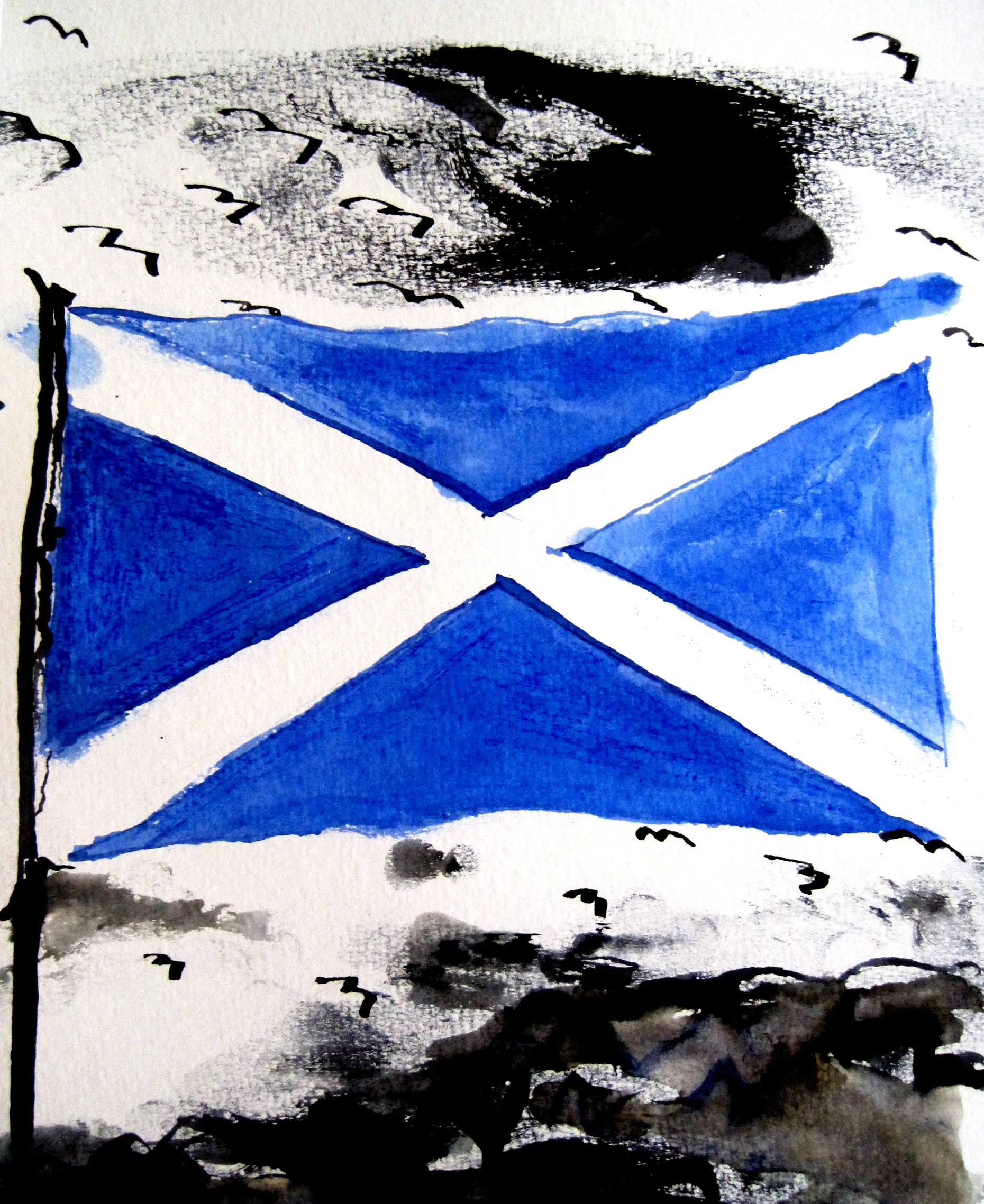
This year we’re flying the Blue Saltire at our masthead as the good ship ARCHIPELAGO jibes and takes the weather’s bearings, steadying sail flapping, bilge pump outlet spluttering, riding light drawing ‘eight and eight’ against the backdrop of a stormy sky. Meanwhile remembering Hugh MacDiarmid aboard the herring fisher Valkyrie (‘lying in his bunk and writing incessantly’) off the Shetlands in 1936, I lie in mine, reading A Book Around the Irish Sea: History without nations by David Brett. Published in 2009, this inspirational study in place and locality has an approach similar in spirit to our manifesto, first published in issue 1 (Summer 2007).

The magazine’s line in referring to an unnameable archipelago has been criticised for denying history. But this is in my view a mistaken response. If you remove the name from something familiar –Ireland, for example; the island of Scotland, Wales and England, or the United Kingdom– do what you will, meaning will rush in, as nature does upon a vacuum, and in the process pose new and raise neglected questions. History will rewrite itself before your eyes. This is the line David Brett pursues. I strongly recommend his book. (I put my hand up to any who know I was born and brought up next the Irish Sea…  swam my first strokes in its waters, made my first voyage upon it, fished in it, gazed up it beyond Eilean Mhannain longing for an impossible glimpse of the Machair of Wigtownshire … and protest my disinterestedness.)

A Book Around the Irish Sea sets the greatest store by the significance of the local and of place and resists generalisation in an exemplary fashion. It clearly derives some encouraging oxygen from the Good Friday Agreement.  I’ve been prompted to read it by the prospect of the upcoming symposium, at University College Dublin, called ‘Over the Irish Sea’ (26-27 April) organized by Dr John Brannigan. (I hope to see you there brandishing your copy of Brett’s pierage.)

Alex Salmond argues that an independent Scotland would inspire radical reassessment elsewhere in the archipelago. There can be no doubt that it would and no one knows what might unfold in such a process. On a cultural front and in a spirit of celebration ARCHIPELAGO has sought to inspire reassessments too, by insisting on the impossibility of naming the whole to the satisfaction of all concerned. At the same time it acknowledges and rejoices in the obvious existence of at least four distinct nations in the archipelago.

Incidentally, it is good to see Alex Salmond in a recent issue of the magazine Planet paying tribute to R. S. Thomas. This is particularly so for those of us inclined to believe, in Shelley’s phrase, that the poets are ‘the unacknowledged legislators of the world’ – a theme on which Thomas wrote in his poem ‘Song at the Year’s Turning’.

Events in Ireland since 1968 have inspired a rich counter-imperialistic cultural production. For deep historical reasons, the Irish have never been able to turn away from England and its language (they should have studied the Welsh, as Eamon de Valera once urged). Grievance and guilt make a strong cocktail and there have been rich pickings to be had from it among Albion’s ‘intelligentsia’ – her reading and theatre-going public – as well as Hibernia’s.

An inevitable want of purpose and meaningful direction has now set in, post-Good Friday, and who doesn’t feel at least a little ‘Irished-out’ at last? Now Ireland falls away, to regroup, for however long, tragically under significantly self-inflicted debt. As it does so, the Scottish Question, rides ever higher on the horizon.

Scotland since Hugh MacDiarmid at least has, it seems, no artistic interest or dependency quite akin to Ireland’s. The days of Burns and Scott are long gone. The road to England continues to throng with robustly ambitious and sharp-talking candidates for careers in political leadership, the legal professions, banking and business, journalism, and (as not in Dr Johnson’s day), football management. But in every other cultural respect of any comparable weight Scotland ignores England and vice versa. (Unless you think there’s something Scottish about the Edinburgh Festival.)

Might independence change any of this, in terms of Scottish literary and artistic production and archipelagic reassessment? It seems unlikely to me but answers on a postcard none the less, for the written word will triumph in the end.

A selection of MacDiarmid’s ‘Shetland Lyrics’ is included in These Islands We Sing: An Anthology of Scottish Islands Poetry edited by Kevin MacNeill and published last year by Birlinn. (Clutag and Archipelago’s Pàdraig Macaoidh is included in its pages.) It’s another book I have with me as I lie in my bunk riding out the times. As perhaps that devoted ocean-going yachtsman Mr Fred ‘Walter Mitty’ Goodwin is also doing – riding out the times, I mean, not reading Hugh MacDiarmid – even as I write and the luxury RBS cruise liner HUBRIS (aka ‘The Ship of Fools’) lists on the rocks, women, children and pensioners last. (May our courses never cross.)

8th February 2012

Posted on

Poets of Calling, Ports of Call

GEOFFREY HILL

It’s 1 January 2012 as I write this. Geoffrey Hill has been knighted and we send our warm congratulations. We are pleased to have been involved in a successful campaign in his honour and to have written at some length to the appropriate mandarins. Sir Geoffrey is very dear to our hearts and much in mind as we work to bring his new book of poems ODI BARBARE to press. The poet takes fastidious interest in typography and production. Currently we are weighing the odds between Bodoni and Clutag’s more customary Garamond and the issue is the look of the italic in the former. What with one thing and another, it promises to be February at the earliest before we have stock. I am sure our customers will understand and forgive the delay. Meanwhile, here is a taster of the jacket (image generously provided by the photographer David Finn). The bronze ‘Head of an Idiot’ is by the sculptor Henri Gaudier-Brzeska (1891-1915), tragically killed at Neuville St Vaast, aged twenty-three and a sergeant in the French infantry, to which he was recruited aged twenty-two.


IVOR GURNEY

Mention of the Great War serves to prompt me to announce that in the wake of our birthday celebrations last November we now plan to prepare a CD of Philip Lancaster singing, unaccompanied and accompanied, songs and settings by the English poet and composer Ivor Gurney (1890-1937; see also Archipelago 3).

ARCHIPELAGO – THE SEVENTH VOYAGE ON THE SEVEN SEAS

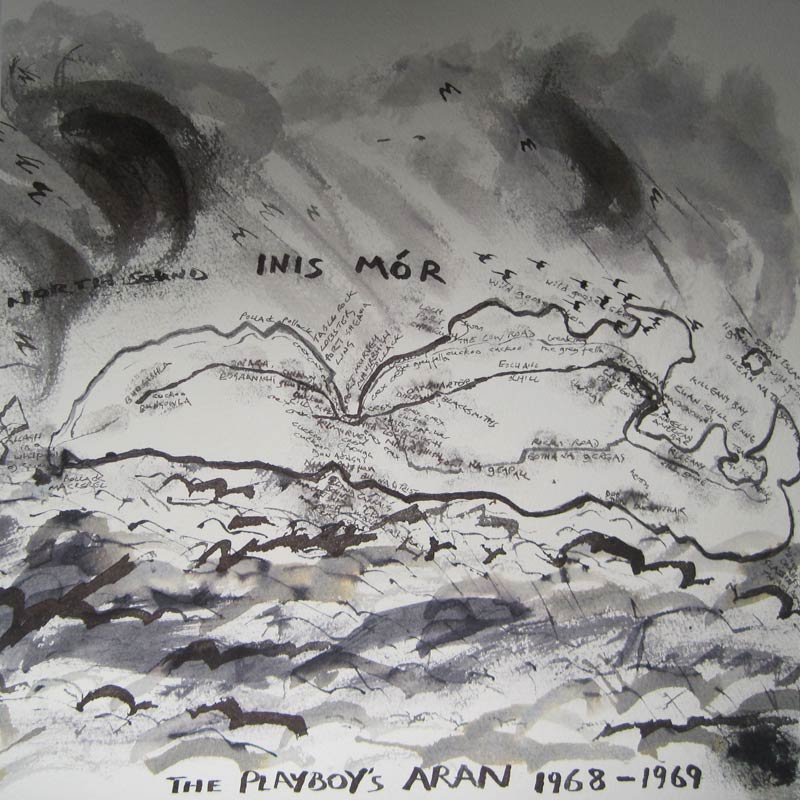
Apart from refitting and provisioning for Archipelago’s 2012 voyaging, we have this year to accommodate two crews – ‘spare everythings, almost, but a spare Captain and duplicate ship’ as Melville puts it in Moby Dick. I refer to: our crew of authors and artists, and our film crew. Making ARCHIPELAGO: THE DOCUMENTARY, as announced in our first blog, will take us this year to many ports of call, among them: Foula, Cape Wrath, Handa, Staffa, Ailsa Craig, Mull of Galloway, Innisfree, Clare Island, The Twelve Pins of Connemara, Aran, and Bere Island. Ever anxious to be of service, I have dug out from the bottom of my ink-well a 1968-1969 map of Inis Mór harking back to the days when I played my part as Árainn Playboy of the Western World in residence. Here it is, for your, I hope pleasurable, disorientation (can you spot the basking shark?). I also plan to visit Inis Mór in May to walk the island with Tim Robinson and have a date to keep on Colonsay.

Once more we greet our friends CAUGHT BY THE RIVER and take pleasure in introducing them and all archipelagians (though you might well be ahead of me) to an exciting venture founded by Mark Cocker and colleagues: NEW NETWORKS FOR NATURE. I am particulary grateful to Mark and to Matt Howard of the RSPB for being in touch and look forward to future collaborations.

We sometimes forget that our tradition is rooted in long-established forms of networking, called Antiquarianism and Natural History, stretching at least as far back as Petrarch and the Renaissance, and notably, in the English tradition, to Gilbert White. I was reminded of this when my friend Angus Martin, poet and social historian, sent me the latest issue of THE KINTYRE ANTIQUARIAN AND NATURAL HISTORY SOCIETY MAGAZINE. We talk much in our uprooted condition of ‘local attachment’ and the authority of the local. The local is said to travel. If it does, it does so on the spot, and happens everywhere and is the product of particular forms of attention, including nostalgia. The real grounded thing is nowhere better practised than by Angus Martin and his colleagues in Kintyre. In the latest issue of their magazine you will find: social history, topography, and natural history (a butterfly report, observations on moths and insect life and bird species) of a kind exemplary and inspiring in its communal spirit. Angus Martin was a friend of the great poet George Campbell Hay (1915-1984). We owe him much for his devotion to the poet and to the world and times in which Hay’s extraordinary gifts were grounded. See for essential and highly enjoyable reading Angus’s Kintyre: The Hidden Past (1984) and The Ring-Net Fishermen (1981) both wonderful books.

HAPPY NEW YEAR to one and all and may 2012 be the best year in your lives to date. Don’t forget our seasonal special offer is still running.

1st January 2012

Posted on

Uncharted Waters

So now the good ship Archipelago makes headway into the blogosphere, uncharted waters for her, beyond the Seven Seas – the Eighth Sea. If water is the word, which it is not, except for the tear in my eye as I wave the shore goodbye. O terra firma! When shall we two meet again? The experience reminds me of the blackest December day there ever was in my notebook. I was out on Galway Bay aboard our mother ship the immortal Naomh Eanna in 1968. The rain fell so hard it seemed to rise back again in a stratospheric ‘double wet’ – a phenomenon described, on a smaller scale, in Katherine Rundell’s ‘Bate’s Creed’ (Arch 4). It fell and rose in towering shrouds of suffocating rain and seemed to reach its darkest intensity just as news came through from the bridge that Apollo 8 had orbited the moon. I had never seen such a black day at sea – dark, dark amid the blaze of noon indeed. It felt like the end of the world, not, as it was, the beginning of a new age in the history of human endeavour.

In an introduction he has written for the catalogue to an exhibition of recent work by Kurt Jackson (Cork Street, London – 15 November 2011 – 26 January 2012 – essential viewing if you can get there), Robert Macfarlane speaks of not ‘life history’ but ‘life geography’. It is the term for much about Archipelago, its beginnings and origins, and future. I find I am currently in the process of attempting to trace those beginnings and origins, on two fronts: one in preparing for the Edinburgh publisher Birlinn (for publication in 2012) an edition of my father’s first novel – Wigtown Ploughman: Part of his Life – set in the Machars of Wigtownshire (McNeillie-land) and for me a founding world in my personal phantasmagoria, due North, directly up the Irish Sea from where I was born and grew up in North Wales; the other in connection with ARCHIPELAGO: THE DOCUMENTARY to be produced by PICTO Productions (of 17 North Main Street, Wigtown, DG8 9HL) under the direction of Shaun Bythell and Jessica Fox. I’ll report news of progress on this front as it evolves.

I am aware that the ‘blog’ as a genre should stimulate conversation and not just provide news. Among the things I want to air, once properly under way, are matters concerning place and landscape, the local v. parochial,  metropolitan v. provincial, centre and margin, deep time and present time – the politics of place, in short, as well as the aesthetics of place, the value and meaning of local attachment, and in the spirit of Tim Robinson’s ‘good step’ the possibility of ‘good work’ in the world. I think medium and message are involved here too.

As some of you will know, Clutag Press marked its 10th birthday on 11.11.11 with an event in Convocation House at the Bodleian Library in Oxford. There were readings by Clutag writers and poets, from work published in pamphlets and books – and in the magazine Archipelago, issue 6 of which was launched that evening. The artist Norman Ackroyd gave a startling, incantatory account of the archipelago, locating one point of his compass in his native Elvet in Yorkshire and extending it 300 miles to the north to describe an arc round the westerly edge of our terrain. Philip Lancaster sang unaccompanied from the repertoire of Ivor Gurney. (See the listing below.) The occasion was recorded and a podcast or Bodcast will be made available in due course. It was also filmed, providing footage and soundtrack for ARCHIPELAGO: THE DOCUMENTARY.

Clutag-Archipelago extends special, warm greetings to all those CAUGHT BY THE RIVER.

Birthday event, readings and performances: Robert Macfarlane read from his Archipelago essay ‘Gneiss’. Bernard O’Donoghue read poems from Archipelago 1 and 3 and elsewhere. James Macdonald Lockhart read from his essay ‘Erne’. Peter McDonald read from his poem ‘Country’ from Archipelago 3. Tom Paulin read from his Clutag pamphlet The Camouflage School. Norman Ackroyd spoke as described above. Alan Jenkins read his poem ‘Sailors’ from Archipelago 6, and a poem dedicated to the memory of Mick Imlah. Katherine Rundell read from her essay in Archipelago 6 ‘Snow mobile’. Andrew Motion read from his Clutag collection of poems about war Laurels & Donkeys. Philip Lancaster sang Ivor Gurney’s unpublished setting of Siegfried Sassoon’s ‘Everyone Sang’. John Fuller read from his Clutag Pamphlet The Solitary Life. Robert Macfarlane spoke about the Archipelago project and its onlie begetter. Philip Lancaster sang Gurney’s setting of his own poem ‘Severn Meadows’ to conclude the occasion.

19th November 2011

Posted on

Caught By The River

We are thrilled to welcome readers of Caught By The River to the shores of Archipelago!

Caught By The River began in summer 2007 and shares much in the way of common ground, and even common contributors, with our own endeavours here at Clutag Press and more specifically with Archipelago. The site encompasses everything from bird watching and urban rambling to poetry, art, gardening and, last but by know means least, fishing.

If you are not familiar with our watery friends we recommend that you check them out, starting with a review of our very own ARCHIPELAGO, Issue 5:

Caught By The River – Archipelago