Posted on

The Last Voyage

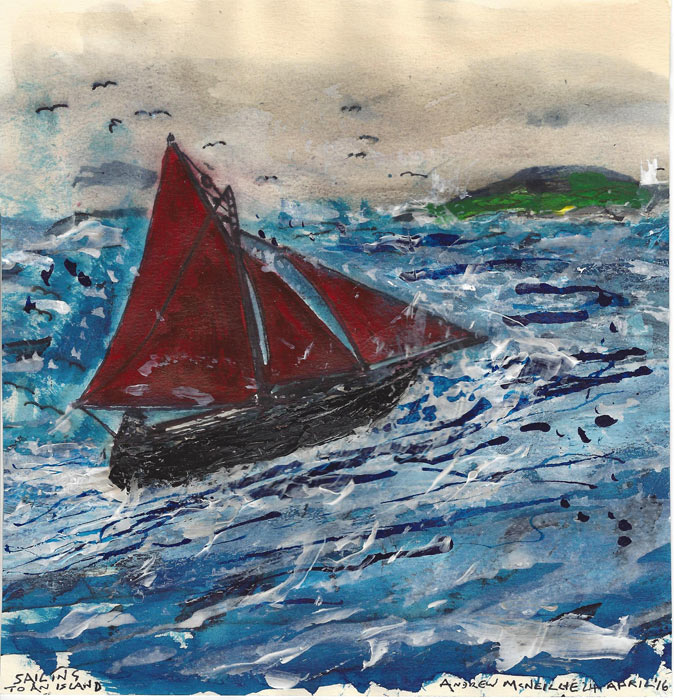
‘Winter Tide: The Last Voyage’  Andrew McNeillie © 2017

If you’ve ever wondered what all this is about, track down Jos Smith’s essay ‘Fugitive Allegiances. The Good Ship Archipelago and the Atlantic Edge’ in Coastal Works (OUP, 2017) edited by Nicholas Allen, Nick Groom, and Jos Smith himself. It gives the richest and most inspired and inspiring account of the project and its origins you could wish for.

Rarely would that same good ship put in at Cill Rónáin, Inis Mór, in August, at the height of the tourist season. But it did this time. And it rained Biblically for three and a half days out of five, with one truly fair day in between, as just deserts for such folly. The place was heaving with half-drowned visitors. ‘Go east, young man,’ I advised myself, away from the tourist trail. So I devoted my stay to exploring a part of the island I’ve tended to neglect in the past. Usually I visit out of season and I’m drawn west to my old haunts. (Next year in November, they’ll be old haunts of fifty years ago. I will head there again, to make landfall 3 November, in foul weather, I hope.)

I can’t claim to know the southeast well. But at least I know where to find it. J. M. Synge drew me to it but in a puzzling way. As I always do I took his The Aran Islands with me, in the little pocket-sized World’s Classics edition (Four Plays and The Aran Islands, 1962) that had been my companion during my original sojourn on Inis Mór (1968-69) – together then with The Plays & Poems of J. M. Synge (Methuen, 1963), a school prize I chose and was awarded in 1965. Both are treasured ‘comfort books’ now, layered with personal association, as also in my bag this trip is Richard Murphy’s Sailing to an Island (1963), in the copy I’d bought in my youth, in 1965, at what was Green’s Bookshop on Dublin’s Nassau Street. (I will be back in Dublin on the Murphy trail on 21 September at an event at Poetry Ireland’s HQ in Parnell Square, in celebration of his 90th birthday.)

On the evening of his arrival on the island, having first walked along the high road to the west, Synge had gone out to the east, beyond Cill Éine and Iaráirne ‘to a long neck of sandhills that runs out into the sea towards the south-west’. Of course the extensive dunes lie to the island’s east, at its southern end. Along the road Synge met ‘a boy and a man’ and asked them if there were any trees on the island. They held ‘a hurried consultation in Gaelic’ at the end of which the man asked if by ‘tree’, Synge meant ‘bush’ – if so, the man told him ‘there were a few in sheltered hollows to the east.’ The bushes or trees, such as they were, lay then,  as they do now, to the west, at Cill Mhuirbhigh.

What was Synge thinking? Was he disorientated? I confess to not noticing this glaring curiosity until recently, more or less on the eve of my visit. It’s the kind of thing we often don’t see as we read. As far as I know, and that might well be not far enough, no one has drawn attention to it before. I apologise if I’m telling you what you know already.

I checked through all the editions of The Aran Islands I own, including the OUP Collected Works (vol. II Prose, 1966), back to the 1912 Maunsel Edition (in which I first read it). All give the same misdirection. So was it a mistake by Synge or by his original editor and or printer? It was I believe one or other of the latter, or both, and then perpetuated by subsequent editors, even at OUP. For in his little essay ‘An Impression of Aran’ (Manchester Guardian, 24 January 1905, reprinted in Nicholas Grene’s invaluable J. M. Synge Travelling Ireland. Essays 1898-1908, Lilliput Press, 2009), Synge makes no mistake: the sand-hills run ‘out into the sea towards the south-east’ and the bushes or trees grow in the west. He knew what he was talking about.

This is surely not the place for such a piece of trivial editorial pedantry, but there it is. I’ve got it out of my system. Or how trivial is it? I like a book about a place to know the place it is about. It is an editor’s job to leave no stone unturned. But here were two left unturned for more than a century. I like east to be east and west to be west, old-fashioned as that might be, never the twain to meet.

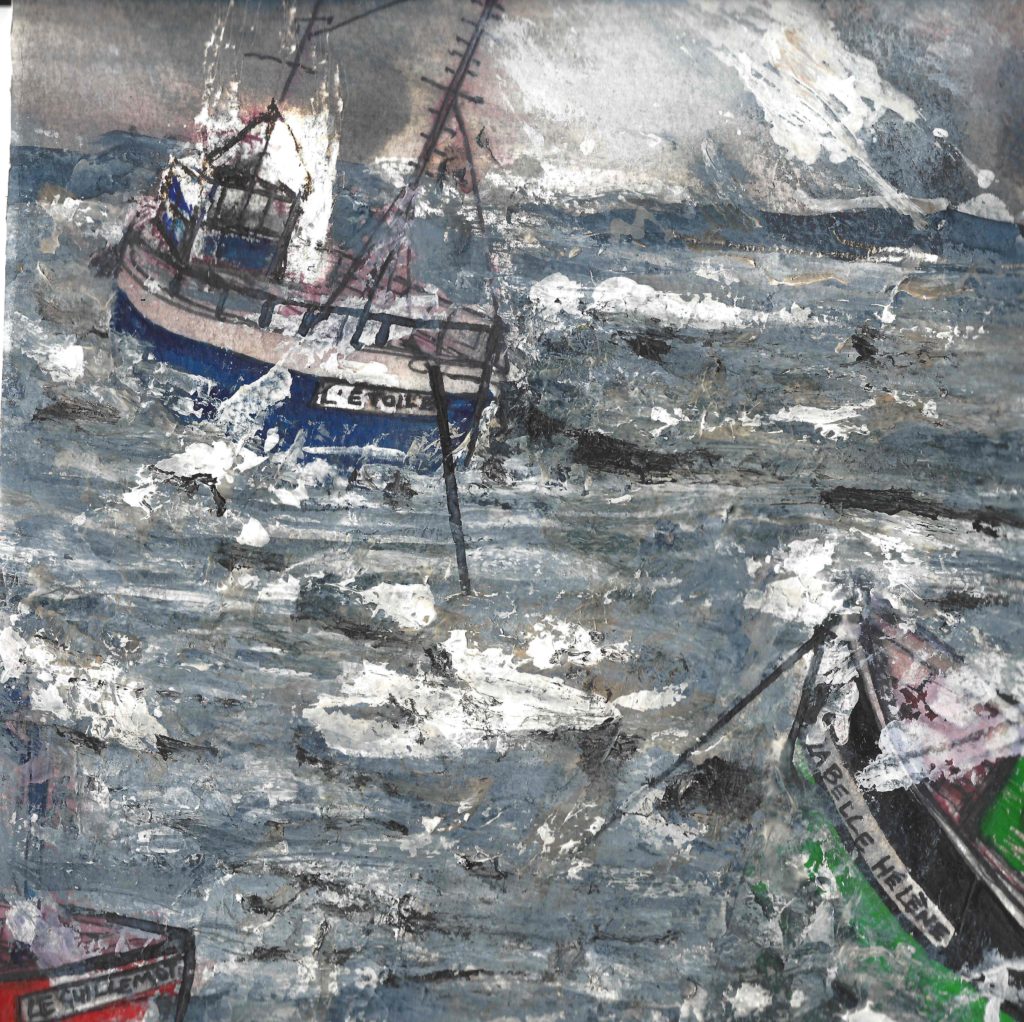
Otherwise I dreamt wildly during my nights on the island, as the image above ‘Winter Tide: The Last Voyage’ suggests – never say worst, never say last? think what became of the Pequod. It’s a vision I had of setting out, slipping harbour in search of Archipelago 12 – which I will do in December, and I hope not end in a ‘Cauchemar on the Rocks’ as portrayed below. Or even worse, adrift with only Queequeg’s coffin (still less my own) to keep me afloat. Though ‘Call me Ishmael,’ has ever been my cry.
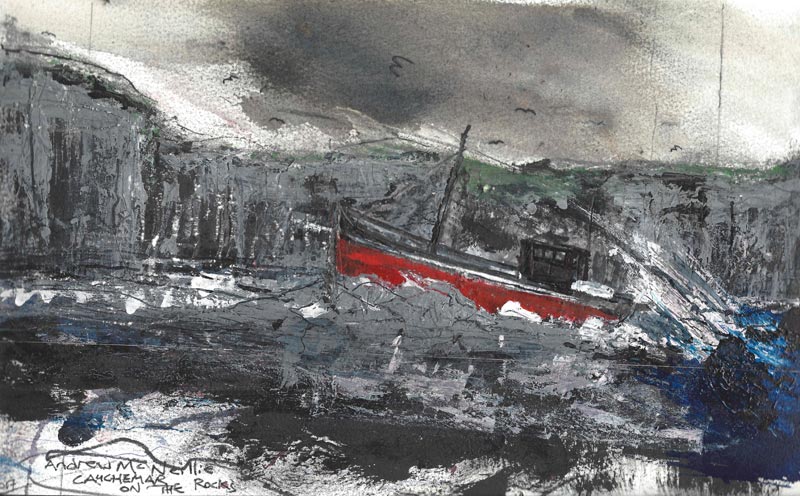
 

‘Cauchemar on the Rocks’      Andrew McNeillie  © 2017


Posted on

Haven

The picture here alludes to a poem by an Irish poet. A free copy of Richard Murphy’s In Search of Poetry to the first and only to the first person to identify the poem. Enter the name of the poet concerned in the subject line of your email to info@clutagpress.com – we’ll publish In Search of Poetry towards the end of April.


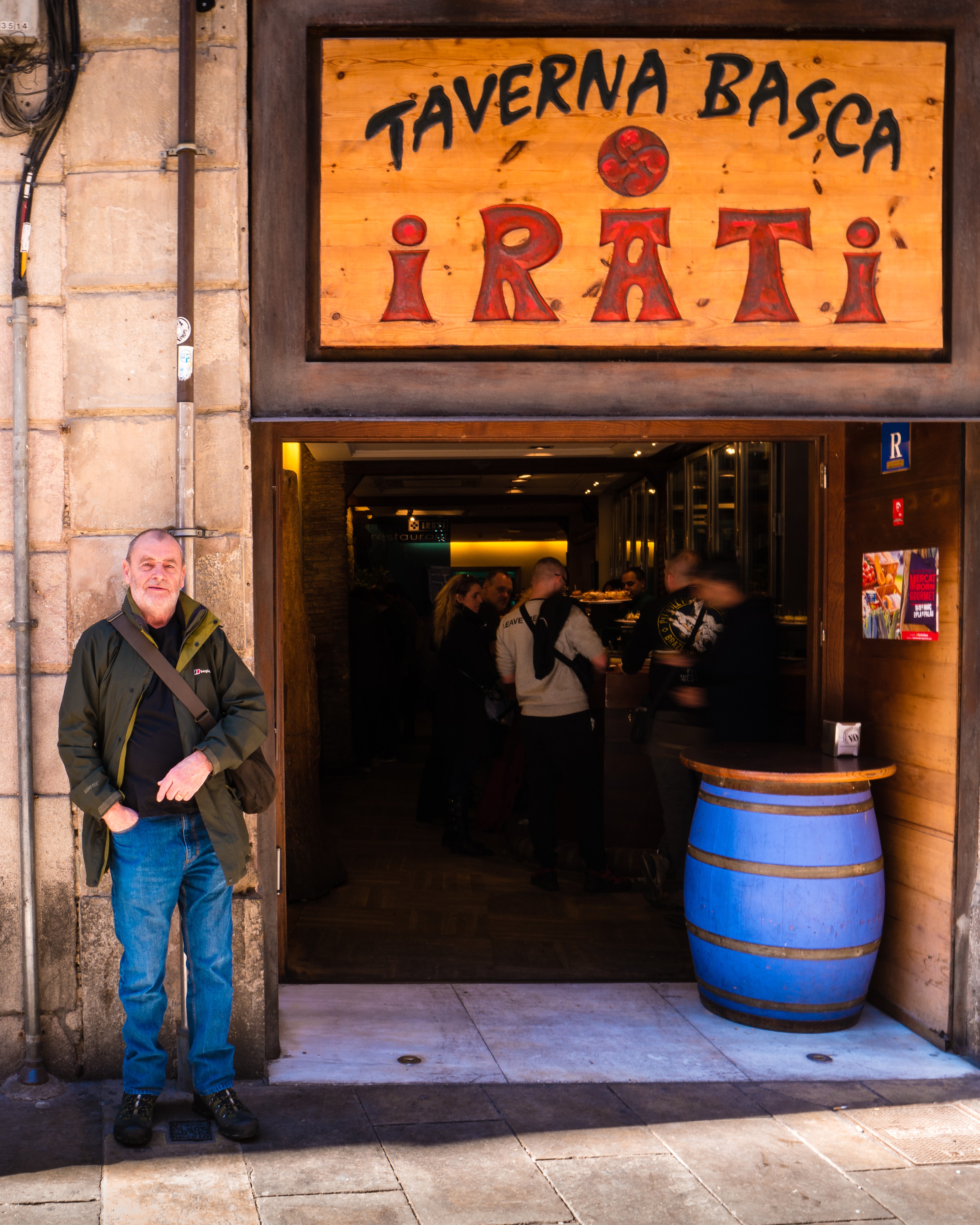
The photograph here, taken by John Sullivan, shows the editor of Archipelago on a recent revisit to Barcelona, outside the Basque Tapas Bar IRATI where the venture was first conceived and aired in a conversation with John, over ten years ago.

Issue 11 of Archipelago is selling well. Issue 12 has been postponed to the end of 2018. That year will also see publication of a volume of essays called DEAD GROUND edited by Andrew McNeillie and James McNeillie, about which we will post full details a little further down the line.

We are especially pleased to announce publication of Patrick McGuinness’s Five Poems – No. 15 in the Clutag Five Poems Series. Please visit the website ‘Shop’ and order your copy.

Posted on

Geoffrey Hill (1932-2016)

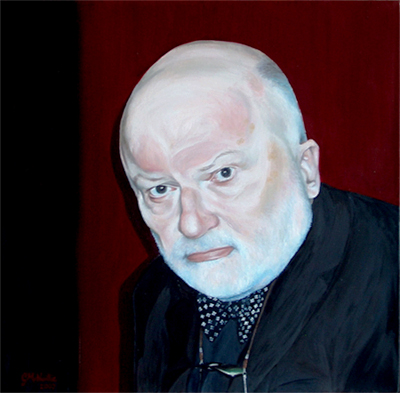
Geoffrey Hill by Gail McNeillie
Oil on Canvas, 2007, 50cm x 50cm
Purchased by Emmanuel College, Cambridge


It was the poet and critic Peter McDonald who introduced us in the end and it began with a phone call. There was a question that Clutag Press might publish a pamphlet of Hill’s current work. Hill was interested I suppose for a number of reasons. He always liked to support a marginal venture. (I’ve been told he lived just long enough to cheer Iceland on in their European Cup victory over England – the English side an example of ‘plutocratic anarchy’ in action if ever there was one.) But why my venture? At hearing my name from Peter he asked, ‘Is that the man who wrote those poems about me in Stand?’ It was. And that, I think, made the difference.

I had published in Stand a sequence of sonnets called ‘Portrait of the Poet as a Young Dog’. Two of them concerned Hill. They derived from an unhappy passage in my life that saw me spend a year at Leeds University where I did no appropriate work, attended few lectures, and almost no tutorials. It is hard to think how I got away with it for as long as I did. I was only interested in trying to write poems. But two things I did do. I attended two courses of  lectures very assiduously, one, a series on aesthetics by Quentin Bell, the other by Hill on poetry from W. B. Yeats to Ted Hughes and Thom Gunn. Hill’s course has become legendary among a subsequent school of Leeds poets, chief among them Jon Glover and Jeffrey Wainwright, graduate students, in my short time there.

So Welsh wilderness-green and wildly shy was I in those days, I wouldn’t say boo to a goose, not even to those two gentle souls. Nothing would have induced me to buttonhole Hill. But I sat in the very front of the lecture theatre and observed him closely. (I could see the beads of sweat on his forehead.) He was I thought wonderfully gloomy, and at times engagingly savage, in his literary criticism (he mauled Thom Gunn with unforgettable brutality), and towards the supposed poetic aspirations of some in his audience. To my mind, fresh out of Wales, he had something of Dylan Thomas about him that surely helped me take to him. I could see (and approve) it very obviously in his early ‘Keble’ sequence ‘Genesis’. He read with a Thomasian sonority and not in the flattened matter-of-fact, uninflected manner of the so-called Movement poets. I have always tended to prefer that.

According to Hill, I caught his likeness at that time, ‘uncannily’ – ‘sweating in his funeral suit of charcoal grey’:


His black shirt, in that artificial light,
caught tenebrous hues, green as Baudelaire
’s dyed hair; his pudgy face so queer,
his brow so damp, as if he spent the night
in hell-on-earth, every day of the year,
and knew he was the only poet there.


It was momentous for me to meet him at last. I did so at Christ Church, Oxford, in Peter McDonald’s rooms. A devoted reader of his work for decades by then, I was awestruck and pretty well tongue-tied before him, no matter he was extremely benign and twinkly-eyed towards me. For his part, Geoffrey could always be difficult to stir into conversation, at the best of times. Though once launched he was invariably magnificent and often Hill-arious. I can’t remember a word that was said on that first occasion but arrangements were made. There would be a publication, a pamphlet. Peter McDonald oversaw an arrangement with the Christopher Tower Trust whereby funds were to be used to further poetry’s cause. So for the first and only time Clutag received a significant grant which comfortably enabled several pamphlet publications including what became Hill’s A Treatise of Civil Power (2005).

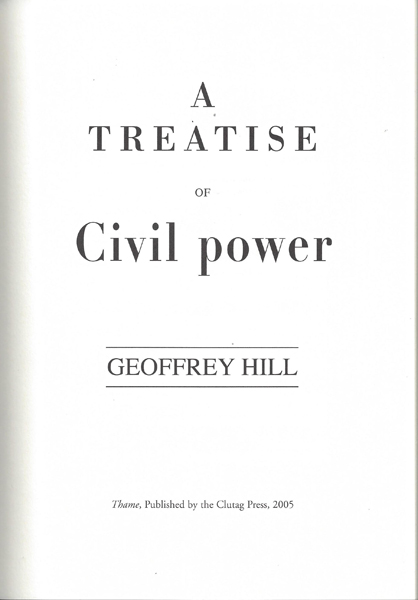
This was perhaps in spring of 2004. I was working at Oxford University Press by then. On 29 September that year I received an email from Ken Haynes (Geoffrey’s close friend, amanuensis and editor) with seven attachments. Six poems and a mock-up of the title page, giving the precise typography and design required, to approximate to, but not to reproduce as facsimile, Milton’s pamphlet of the same name, down to the place of publication:

Treatise-title-page

The poems were set and proofs made ready. But progress was delayed by the addition first of one poem and then another. These were sent in a most apologetic manner. I was at liberty to turn them down. I wasn’t so foolish and what began as a pamphlet expanded, not unalarmingly, in terms of binding, into what Geoffrey called a ‘booklet’. It was a brilliant new start for Clutag Press which up to that point had trafficked only in small two-page leaflets, hand-set on an Arab printing press. (I should say that the version of the title poem in the booklet’s pages is to be found nowhere else and is in my view far superior to the one subsequently published in the book of the same name.)

As you will know from the website Clutag Press went on to publish two books by Geoffrey Hill and to issue a CD of a reading he gave in Oxford’s Sheldonian Theatre. I would sign up his critical writings for OUP, and also his collected poems. In that time I got to see Geoffrey regularly, in Boston, Oxford, and latterly in Cambridge, and enjoyed his great warmth, extraordinary kindness, and personal concern (for my and my family’s well-being). He was deeply proud to be a copper’s son from Bromsgrove and that was a starting place at which it was most comfortable, and often most illuminating, to meet him. He was an intellectual giant but the artist in him held a simple ground too. I saw this very clearly once when, on the morning after his Sheldonian reading, 2 February 2006, I drove him to Kidderminster where his wife Alice Goodman was then living, serving as an Anglican chaplain there.

I slowly realised as we travelled farther and farther from Oxford and nearer and nearer our destination that we were on a nostalgia journey, into the realms of Goldengrove, into Offa’s territory, and the nearer it we got so he became more and more animated. He seemed to radiate sensual pleasure. At one point, as we passed on the other side of the road, a great black steam engine on the back of a low-loader, I thought Geoffrey was going to jump through the roof of the car at the sight of it. He was like a child in his excitement. Here was the past made manifest, here was childhood, here was the Eden of the West Midlands in transit, here was memory redeemed in the moment. We had to take particular roads. I had especially to see the sand quarry in which the young Offa – after flaying Ceolred – ‘journeyed for hours, calm and alone, in his private derelict sandlorry named Albion’. This was the territory of ‘The Jumping Boy’, who is celebrated so marvellously in Without Title (2006), then newly published.

I have far too much to relate about him than is appropriate here and now. The fact of his death – though I had heard he was ill – came as such facts do as a shock of numbing force. He was a literary giant, a staggeringly learned man. That I of all people should ever have known him and been numbered among his friends still seems as incredible to me as it would have done to my youthful, delinquent self at Leeds in 1965.


3rd July 2016

Posted on

Sailing to an Island

A week ago at the time of writing this, I had an email from Philip Marsden, one of our prized Archipelago contributors. He told me: ‘I leave for Dingle at dawn on Friday’. It was the stirring opening to a poem, for sure, the ring of Auden’s ‘Leave for Cape Wrath tonight’ about it, though none of the period desperation. By now he’ll have that first leg of his single-handed voyage from Falmouth to the Hebrides behind him. We hope to rendezvous up there somewhere weather and time permitting. But whether we can or cannot, he will have had the better part of it by many a sea-mile. I can only imagine what poignant and vigorous wonders there’ll be in his log.

Just as I heard from him I was sorting out a trip of my own, to take part in the Inishbofin ‘Island Conversations‘ Festival (2-6 June 2016), an event organized by Peadar King. I believe I’ll be there in the company of Norman Ackroyd, Michael Longley, Bernard O’Donoghue (all long-term supporters of Archipelago) and a host of others, and I thought it the moment to give you advance notice, to encourage you to book your place and support this vital fledgling project.

Inishbofin is of course indelibly associated with the Irish poet Richard Murphy and above all his landmark-seamark volume Sailing to an Island (1963). Murphy is the unacknowledged legislator behind the Archipelago venture, which itself first surfaced in November 1968, at Cill Rónáin harbour, Árainn – long-ago now when the fishing, while not what it once was, was far better than it is now in the threadbare seas of today.

Dancing Days for Fishing

She holds nothing steady on land or sea today.
But what-ho! proclaims, What-ho! her name.
Her compass needle dances a delicate ballet
pirouetting en pointe. ‘Where, where, where …’
the gowned waves chorus.

Gulls in mobs clamour in the gods.
The mountains pitch and roll
like whales breaching among clouds
and the island at its mooring
spouts and spouts again all morning.

She parts the seas, thumbing through
for half-remembered lines,
myopic as late mackerel blinded by the light –
as jigging in mid-air they used to come
when time could count itself so lucky

that it could catch a hand and a tilly hand …
that it could see so many all at once
to string through the gills
a youth’s share, as nevermore
to hang on a handlebar for an encore.

Andrew McNeillie


If you do not know Murphy’s work – shame on you, until you obtain his collected poems from Antony Farrell at the Lilliput Press (which includes some notes on the poems by the poet, and a piece by Bernard O’Donoghue on ‘Pat Cloherty’s Version of The Maisie‘).

I’m counting on seeing you on Cleggan quay, waiting for the ferry. Don’t let me down, now, and remember, carpe diem:

I wait on the quay
And the quay waits.
There’s many a thing more lasting than person
I hear it say
At no great length.


9th May 2016

Posted on

Devolved Voices

Interview: Andrew McNeillie
Andrew McNeillie was born in North Wales and read English at Magdalen College, Oxford. An editor and publisher, including a stint as literature editor at Oxford University Press, he has also held a…

Listen to Andrew McNeillie interviewed as part of Devolved Voices, an exciting three-year research project based at Aberystwyth University. The project considers the development of English-language poetry from Wales since the vote for devolution, with a particular focus on those poets who have emerged since 1997.


28th July 2015

Posted on

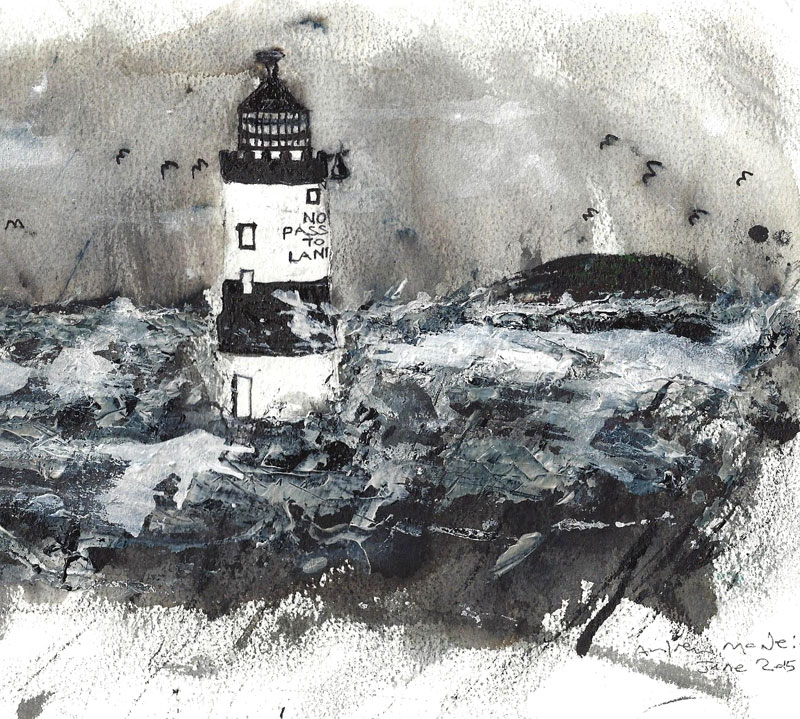
No Passage to Landward

In large capitals on the lighthouse
But caught too late for us to change course.
 
We sail towards catastrophe.
Our epitaph-in-waiting: lost at sea.
 
Sure of this in all the world:
The sea alone will keep its word.


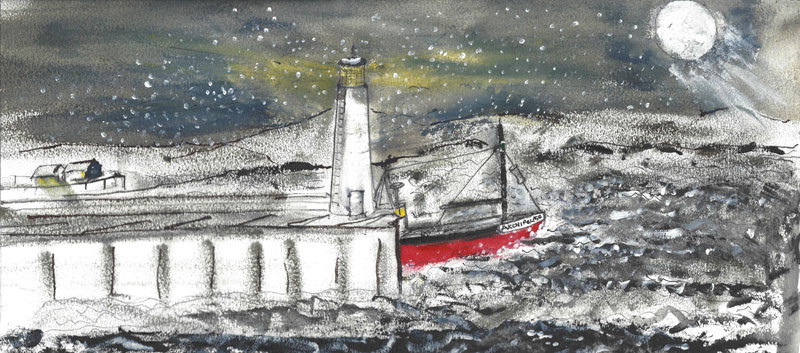
If ever there was a timely moment to reflect on there being NO PASSAGE TO LANDWARD this is it. The lighthouse concerned stands off Penmon Point on Anglesey, beyond it Puffin Island.

We’re delighted to say that Archipelago 10 is on course and might even put into harbour ahead of time. Contributors: Norman Ackroyd, Julian Bell, Mark Cocker, Kevin Crossley-Holland, Tim Dee, John Fanshawe, John Greening, John Jones, Angela Leighton, Stephen Pax Leonard, James Macdonald Lockhart, Robert Macfarlane, Bernard O’Donoghue, Angharad Price, Tim Robinson, Padraig Rooney, Mark Roper, Mary Wellesley.

It’s a special landmark issue. We’ll publish in November as usual and launch in Oxford on Saturday 14 November at Somerville College in association with the Atlantic Archipelagos Research Consortium. Details of the AARC colloquium will be posted in due course. There will be talks and papers during the day, and performances and readings in the evening. Sign up for both. Tim Robinson will introduce a showing of Robert Flaherty’s classic ‘Man of Aran’, the movie that inspired him to make his Aran pilgrimage.

 PLEASE DO ORDER YOUR COPY OF

ARCHIPELAGO 10

IN ADVANCE if you haven’t done already. It helps us no end.


6th July 2015

Posted on

Night & Day

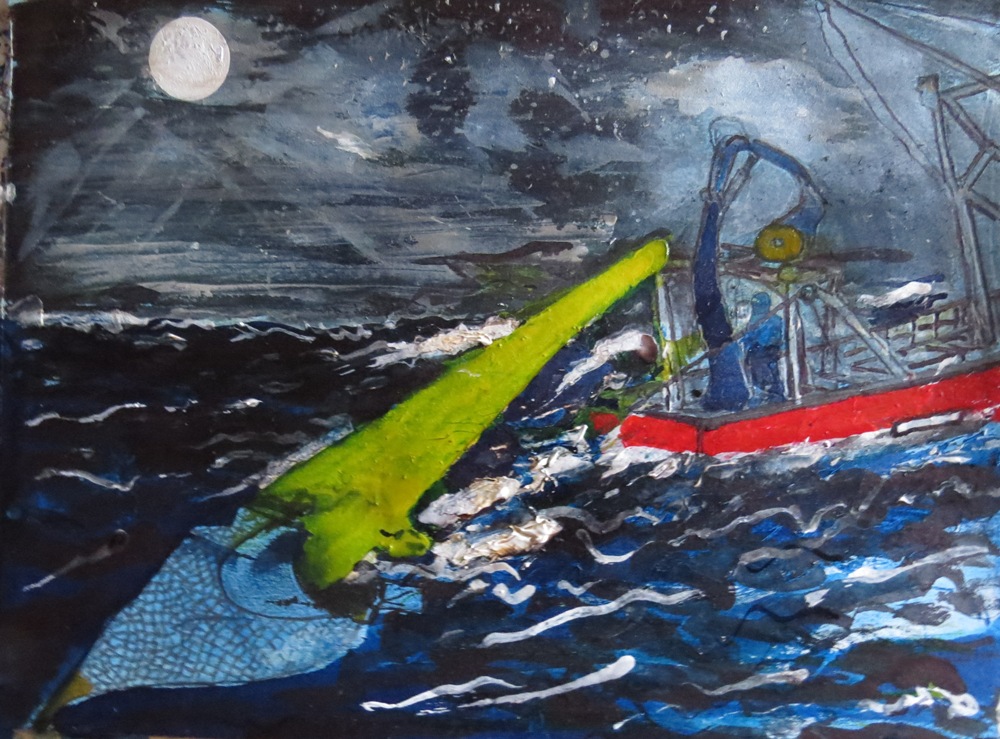
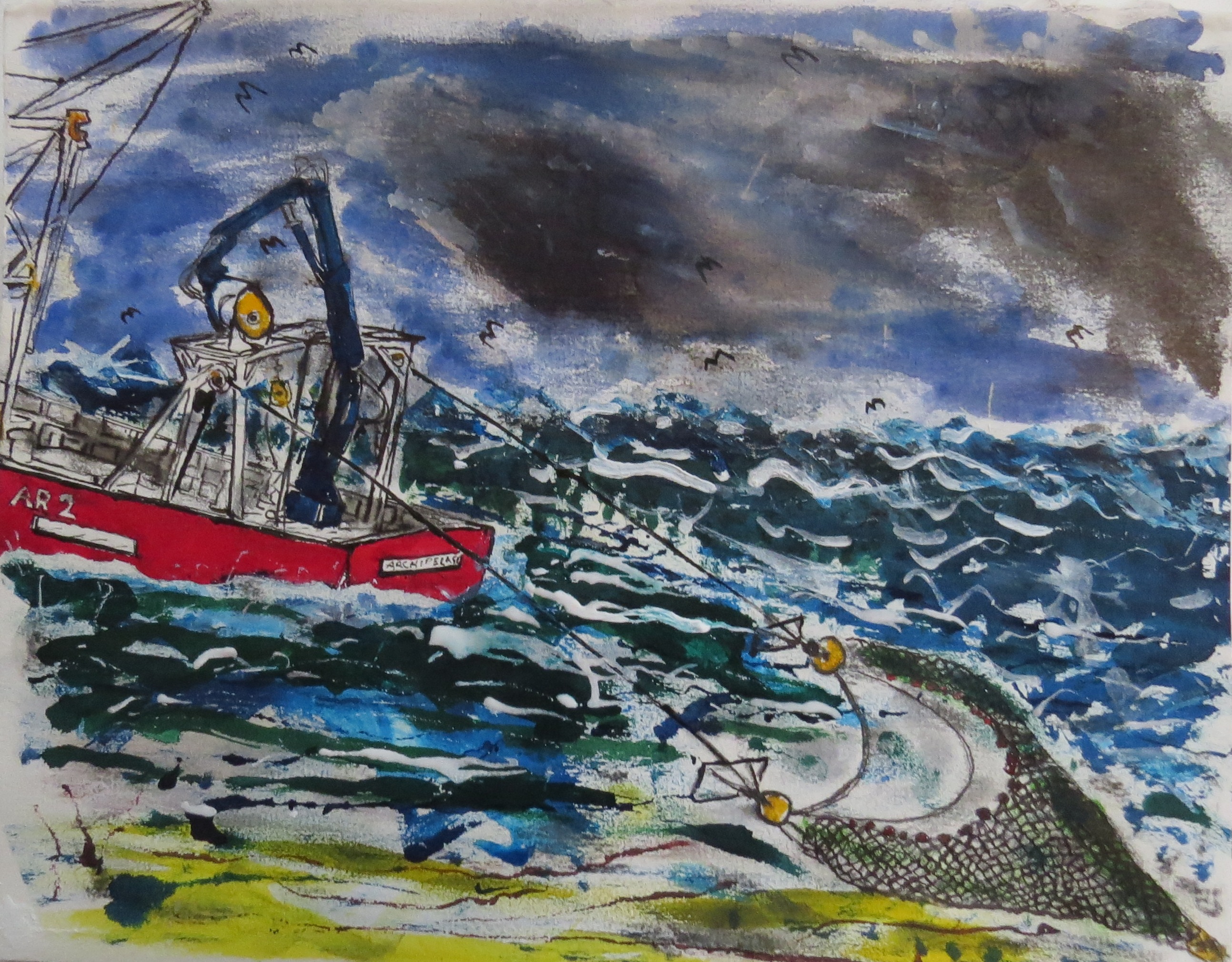
A hardy reader of the magazine scuba diving off Slyne Head in the cold March seas has just tweeted the two images reproduced here, top and bottom. We are pleased to re-tweet and hope you will all follow suit. A free copy of Archipelago 10 to Gráinne Ni Cormac of Westport when the time comes.

And for once we know not only the time but mirabile dictu also the place. Please enter this in your old-fashioned diaries or, if you think they have a future, your digital devices. In association with Somerville College, Oxford, and the Atlantic Archipelagos Research Consortium, we are holding a day of talks and an evening of readings and musical performances to mark our seamark tenth issue on Saturday 14 November 2015. ALL WELCOME. Archipelago 10 will be published that day.

The day’s proceedings will conclude with a showing of Robert Flaherty’s ‘Man of Aran’ movie introduced by Tim Robinson. As plans stand, there will be keynote talks in the morning by Norman Ackroyd (including extracts from the television documentary ‘What do artists do all day?’) and Robert Macfarlane.

We’ll update you as the programme and attendance details take more precise shape. But rest assured the event will take place. In the afternoon there will be two panels of talks and the rubrics for these will be defined by compass point: Southwest, Northeast, West and so on.

Already aboard for issue 10: Norman Ackroyd, Mark Cocker, Tim Dee, John Fanshawe, James Macdonald Lockhart, Robert Macfarlane, Bernard O’Donoghue, Angharad Price, Tim Robinson, Padraig Rooney, Mary Wellesley, David Wheatley. Please help keep us afloat by visiting the shop and ordering in advance of publication. As ever we will mail as soon as we have copies, first come first served. Back number are available for all issues, except 8, and only in a few copies in some instances, including the reprint of issue 1. So don’t put off to tomorrow what you ought to do today. The sales are what makes the difference. For us, it’s all about:


Making Ends Meet

Since you ask, I think of a door into the light,
Light enough to make me blink and rub
The sleep from my eyes. Limestone light
Backlit by sea. Light like a shadow
Falling outside-in, on a stone floor.
And a kettle rattling to life loud as shingle,
Its breath billowing like my own
As I lean there in the jamb, sipping hot tea,
Contemplating, savouring sea-light.
The tide out below. And the early worm
Already turning in a bird’s gut
Like the one thought in my head
Of lines to set and bait to put
Some poem on my plate by evening.
Do I miss it? Not for a minute.
I have the best of it wherever I go
And the rest of it is everywhere still
Struggling to make ends meet.


Warm congratulations to Robert Macfarlane on the publication of his new book Landmarks.


15th March 2015

Posted on

Hope and Anchor


We’ve been holed up proofing Issue 9 at our favourite hideaway quay in the wild west. The place is otherwise more or less unused other than by seabirds, hoodie crows, and the occasional lobster looking for a telephone. Unused, that is, except for nefarious ‘black-catch’ deals at the backdoor of the local gastro-pub THE HOPE AND ANCHOR. The proprietor is himself struggling to survive. As are the fish he pays through the nose for. Just as we are in these hard and uncertain times.


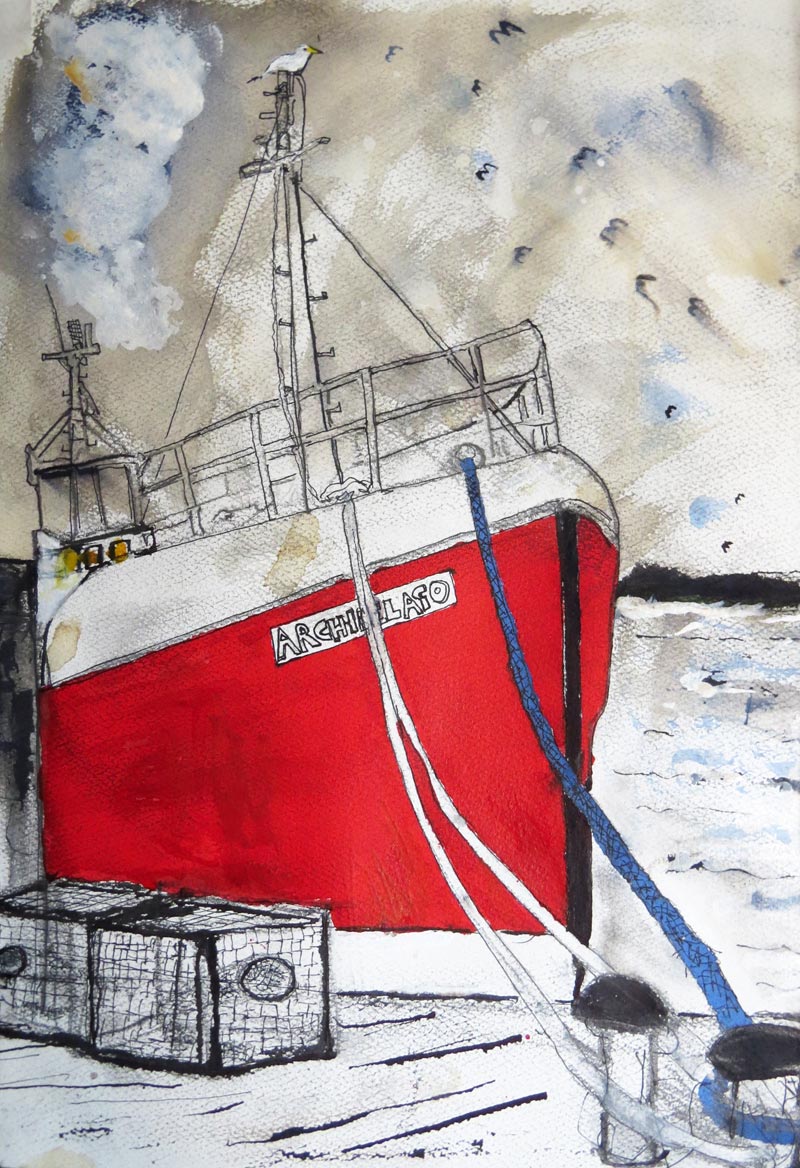
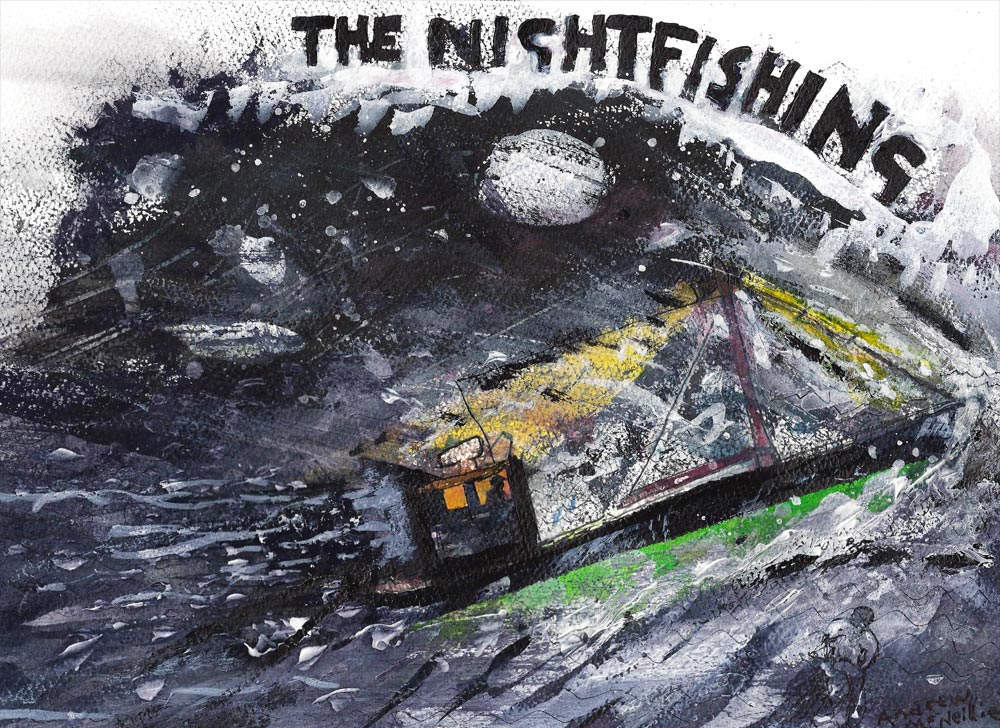
I took this picture of the good ship with my old box-brownie app. and a reel of Kodak Colour. I thought I must ‘share’ it with you, comme on dit. What’s with the French? I hear you ask. We’ve been hanging out off Finistere with some ‘Frenchmen’, pair trawling for new authors. It was our only lingua franca and its traces seem to have got round my tongue.We were otherwise completely in the dark but for a little moonshine.


The-Nightfishing-Scan0003


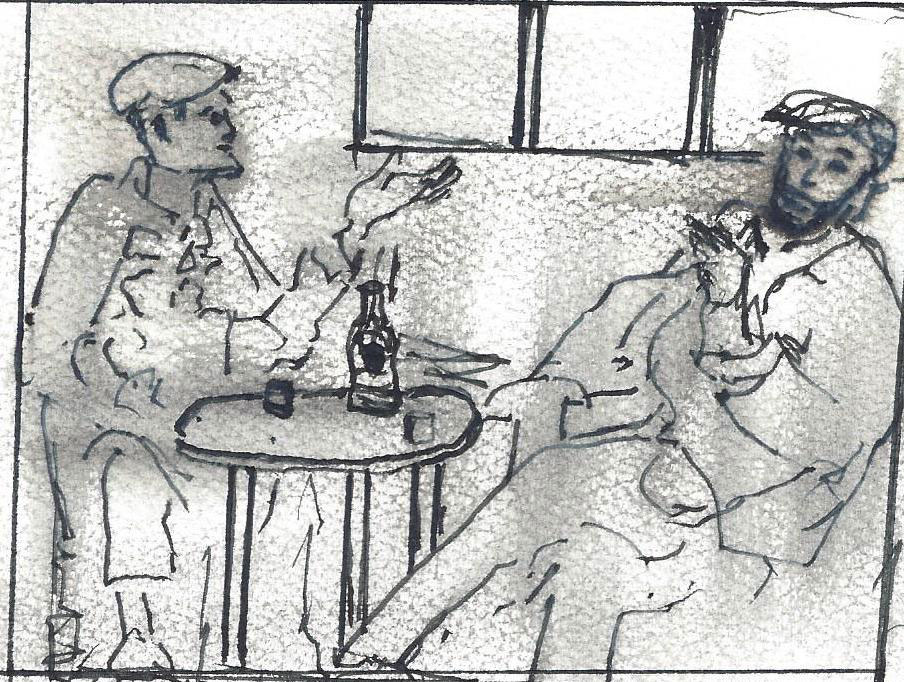
The really good news is that we’re not far off going to press. As you see from my quick sketch of ‘James Macdonald Lockhart and “Himself”‘ in the back room at the HOPE AND ANCHOR, animated speculations as to our next trip are already in the air.
James-Macdonald-Lockhart-and-himself-plan-their-next-trip-in-the-bar-at-the-Harbour-Inn-Scan0001


I suppose it’s also good news that we’ve had to put Issue 8 out of print. It has ‘flown from the shelves’. I wish I could say it has made us rich. But that’s not how it works. The only other issue now out of print is Number 1. We’re exploring the possibility of doing a short-run reprint. If you are missing a copy of the founding issue, please let us know. It will help us make our decision to go ahead if we get a good response. If you want issue 9, move fast . . . or weep alone.


Andrew McNeillie

3 October 2014

Posted on

‘The beautiful island . . .’

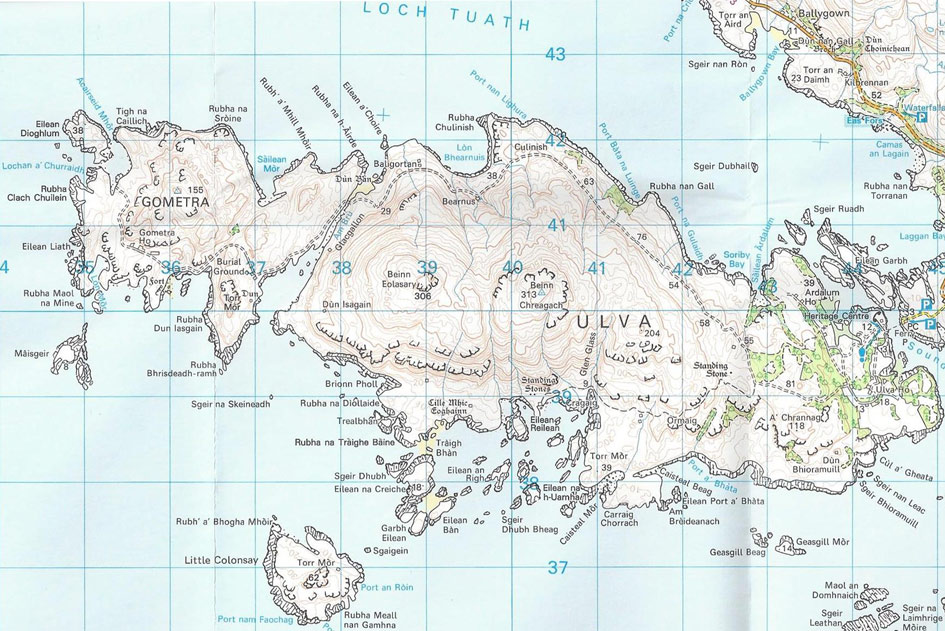
This is to mark the death of Iain Munro, crofter, boatman, and inspiration to all who had the privilege of meeting him. He drowned on the night of Friday 15 May, off the north coast of Ulva, making headway to Gometra, in a small RIB powered by a single outboard. His sole passenger, Andrew McNeillie, by some miracle made it ashore, at Port Bata na Luinge, round the point of Rubha nan Gall, and survived, managing eventually to raise the alarm at Gometra House at about 7.30 a.m. The two had spent the afternoon and evening together on Mull, erecting fencing against deer, and running errands on a dreich day with a mounting southerly wind. There will be a funeral service at Salen on Mull on Tuesday 27 May, and burial on Gometra at what must be one of the smallest graveyards on earth.

 Archipelago has made much metaphorical play with the languages of the sea and of disaster at sea. But no figure of speech can avail at a time like this. John Donne didn’t say ‘no island is an island, entire of itself” though he might as well have done. But he did say ‘any man’s death diminishes me’. Iain Munro was not just ‘any man’. It is the hardest truth that he is no longer alive and working to keep what he called ‘the beautiful island’ of Gometra afloat against all odds. The next issue of the magazine will be dedicated to his memory. It will carry an essay ‘Cause & Way’ about Gometra by its owner Roc Sandford. Andrew McNeillie was travelling out to see the island for himself, to meet Iain Munro, and to discuss the essay, at that point nearly in its final form.

Andrew McNeillie

22 May 2014