
Norman Ackroyd
Katherine Rundell
Norman Ackroyd
Katherine Rundell
I was in Ireland shortly after Seamus Heaney’s death, in Dublin, then on west to the Aran Islands. Both as seen from the Poolbeg Light on the South Wall at the mouth of the Liffey on a blowy day and rising tide and from a storm-bound Aran, Ireland seemed a smaller place without his presence, somehow empty, empty as a fish-box washed up in the tidemark.
Issue 8 of Archipelago is dedicated to his memory. I’ll not repeat here what I say in its Editorial as to his support for the archipelagic venture. But the issue has for frontispiece a collaborative work by Norman Ackroyd and Seamus Heaney, in which the poem ‘Postscript’ is ghosted over an etching of Inishtearaght.
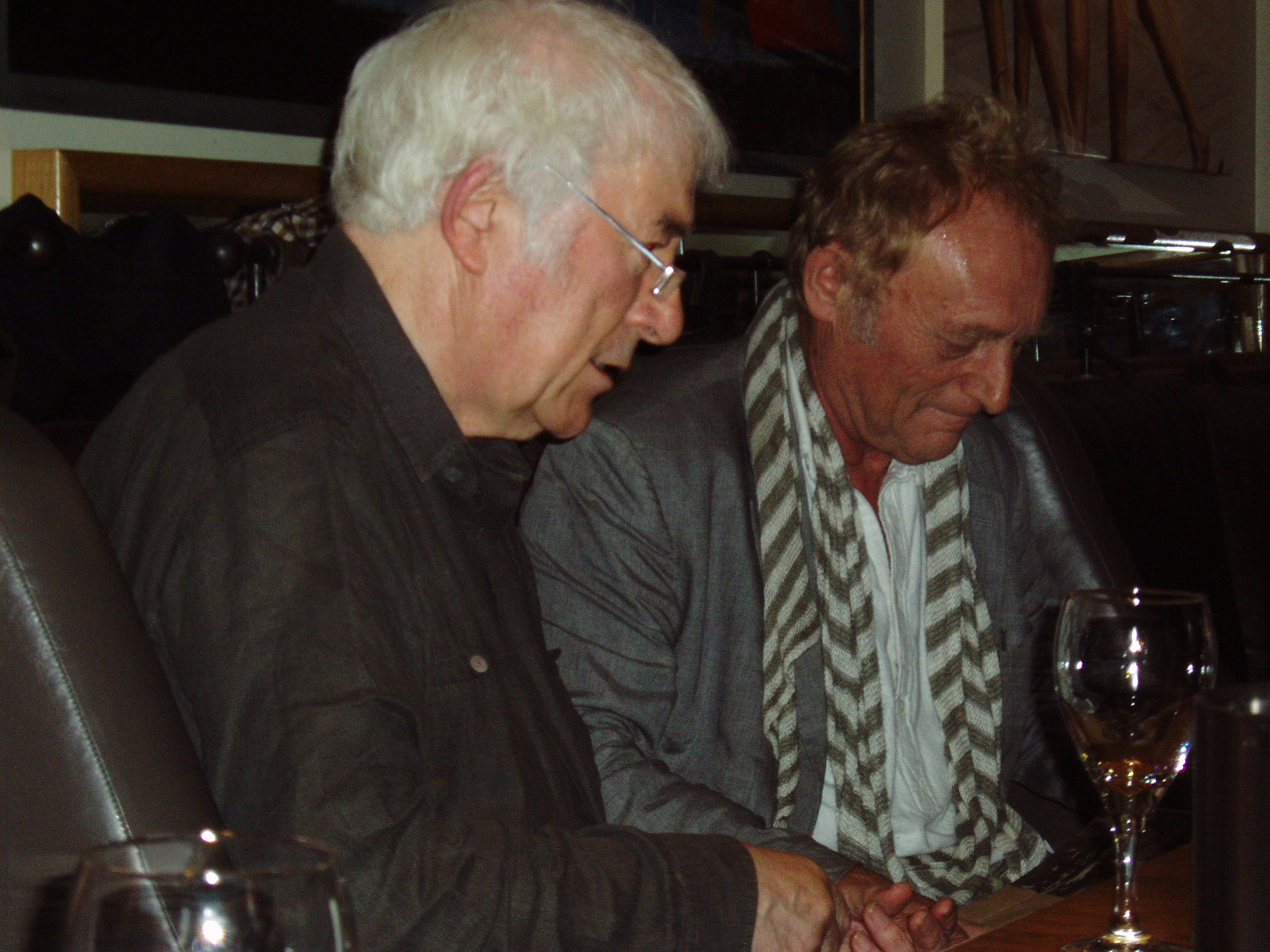
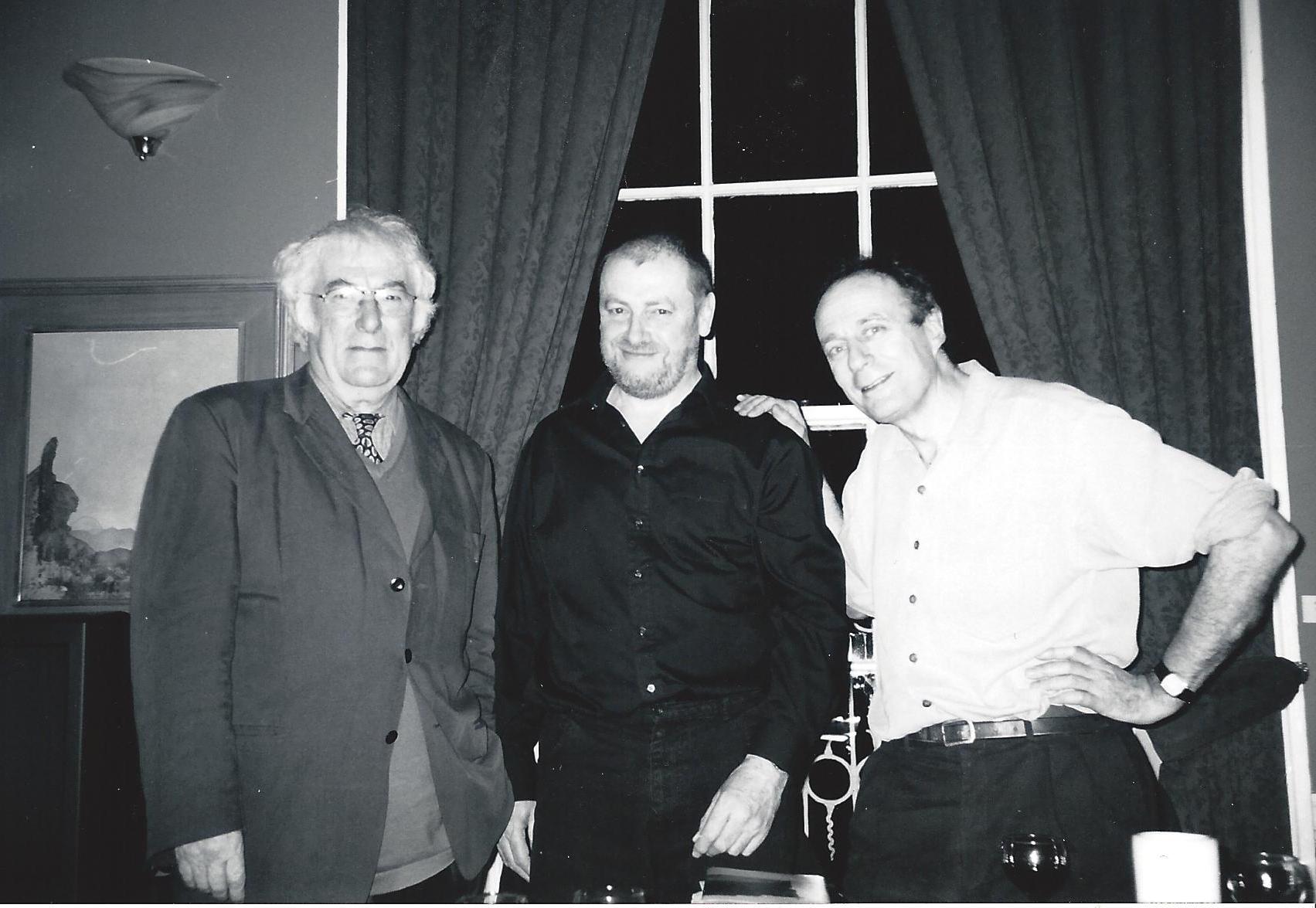
The photograph here of the two men together dates from an Archipelago/Clutag Press event at the Bodleian Library. Also here a snap showing Seamus Heaney and Tom Paulin with the author of An Aran Keening in the Irish Writers’ Centre, in Dublin in 2001.
Issue 8 of the magazine has been seen on the horizon. It is due to make harbour early in November and in its hold a DVD of Clutag Press’s 10th birthday celebrations, produced by Shaun Bythell and Jessica Fox of PICTO Productions. If you haven’t ordered your copy of issue 8 yet, now’s the time, before the print-run sells out. Among those starring: Norman Ackroyd, Robert Macfarlane, Katherine Rundell, Tom Paulin . . . .
The contributors to the new issue are, in alphabetical order: Norman Ackroyd, Mark Cocker, Rachael Cocker, Alan Counihan, Peter Davidson, Nichola Deane, Tim Dee, David Douglas, Douglas Dunn, Rody Gorman, Kirsty Gunn, Kerrie Hardy, Geoffrey Hill, Angus Macmillan, Andrew McNeillie, Sinéad Morrissey, Bernard O’Donoghue, Alan Riach, Helen Tookey, David Wheatley.
Andrew McNeillie
21 October 2013
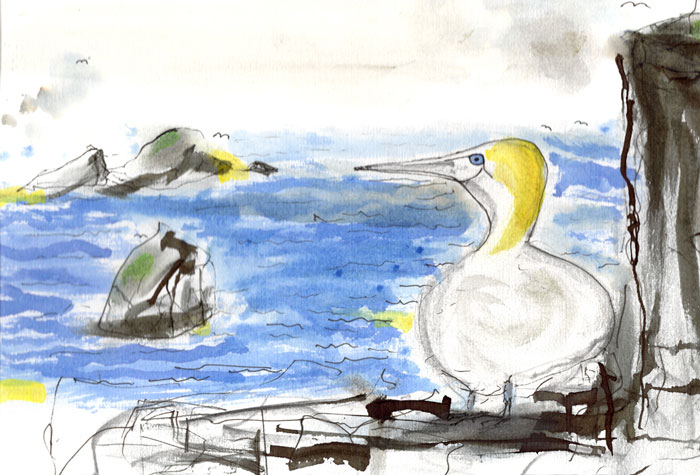
I should have asked my friend the gannet before I set out, for a gannet’s eye view of the chances. But it was not to be and I knew it in my heart. I knew it in my bones as I stepped off the plane in Steornabhagh (21 May), though I took everything I could as a ‘sign’ to the contrary. My plan was to explore Lewis and then go south to join a party of friends (old and soon-to-be) at Tairbeart on Harris in readiness for the word from Angus Campbell to haste ye to Leverbrugh and embark. It was not to be. I knew it literally in my bones next day as I walked in a bitter northerly, lashed by sleet and hail, the two or three kilometres from Port Nis to the Butt of Lewis, the buffets enough to stop you in your tracks. I staggered on into the brunt like a man coming home late from the pub in the old days. I had not seen the Butt before. As I went along I joked to myself as to what it might be to merit the walk on such a day. I thought of a grouse butt for coastguards to peer from through their telescopes. But then I saw my first sign of beneficent providence, a little flock of Snow Buntings doing what they could to hold their own along the cliff-top. Next an Arctic Skua crossed westward at eye-level just in front of me. I had never seen either species before. I pinned my hopes on them and bade those hopes stand fast like the Butt of Lewis Light itself.
The next day, despite high winds and strong bouts of rain, I fished for trout in the only remotely sheltered corner of Loch Acha Mòr and caught four brown trout on a Black Pennell fly, as recommended to me by the man in the fishing shop. It was a fly I had in my box, a stand-by in my native North Wales too. I would have felt safer with three fish, but four would do. I had signs in abundance. All would be well. We would reach St Kilda. Though the cuckoo on the hill and called me a fool countless times.
On the Saturday I drove down early for Tairbeart. A loch on the left of the road took my fancy and I decided to stop and cast a fly at it. It was a bleak day but the water seemed in great condition. I fished without success for an hour and more, by now some distance round the first bay when I heard shouting and, looking up, saw two men, the bigger of them waving his arms, and calling ‘NO FISHING! NO FISHING!’ I hurried round to them having shouted back my apologies. I felt the big man’s hard stare on me as I came along. Then he looked away as we began to make closer eye-contact, as if to maintain his authority. ‘I am sorry,’ I said. ‘I was told …’ ‘What’s your name?’ he demanded. He was indeed a big man. I told him my name. ‘Well, Mr McNeill,’ he replied having misheard, ‘my name is Michael and I am the bailiff here. This is private water.’ Perhaps I wouldn’t make it to St Kilda after all? Perhaps I’d be up before the bench come Monday. ‘Fishing for trout are you?’ he asked. I said I was. ‘Well this is salmon and sea-trout water, part of the river system, a class B water… Did you catch any?’ He studied my face closely. ‘No,’ I said, ‘no.’ ‘Well, of all the hundred lochs here you picked the only one you’re not allowed to fish,’ he smiled at last, a little. Then the two escorted me back to the road. As we went I told them the purpose of my trip. ‘Were you ever on St Kilda?’ I asked. ‘No,’ said Michael, ‘but my wife was – the worst sea-crossing of her life . . .’ ‘A man I met in Steornabhagh,’ I launched out, ‘told me his father had been there, for a wedding. The minister went out with them on the boat.’ ‘I knew a man was married there six years ago …’ said Michael at once. We both guessed it was possibly the same wedding. ‘Yes, he married, and then he went to Australia. A Lewis man …’ I shook his hand. His silent assistant smiled a quick unofficial smile and Michael wished me a happy holiday. I put away my gear and drove for Tairbeart.
That afternoon I took the narrow winding way to Hushinish, and on the Sunday rose early to go spotting for a golden eagle at Sròn Scourst, along the track to Bogha Glas, by Loch Scourst. There is a hide near the pass there, but I don’t like to be served up ‘Nature’ in that way, and I went off piste and lay among the heather, staring skyward for an hour or so, but nary a sign of a golden eagle. I said to myself, you’ve got as much chance of seeing one as you have of going to St Kilda. Then almost as soon as I had the thought, there the eagle drifted out above the skyline, high above the ridge, not a wing-beat but once or twice a slight closing and opening of the wings, and then away it sailed out of sight over the rocks. An omen indeed. I had first seen a golden eagle as a boy in the OBSERVER BOOK OF BIRDS and never saw one since, beyond the covers of a book or on TV, until that moment. My binoculars brought it nearer but not near enough. Still, what better sign?
Later that day, climbing to the ridge and back down again, as you will see in the poem below, I saw a mountain hare, in two-tone transition, and found a red-deer antler in deep heather. What better signs? But it was not to be. The wind turned southeasterly, the seas cavorted, we would not reach St Kilda on either of our two possible days. On the first possible day my new friends and old (Gordon Campbell and Mary) saw two golden eagles. Surely promising for the next day? But not so. I tried to make out that not sailing to St Kilda was as rich a theme as making landfall there on Hirta. But little by little disappointment prevailed and for me persisted despite the good company I found myself in: and the music and song of John Peppard and of George Thomas; and a retreat to Carol Boyd’s neo-Scottish Laird’s hoose, Crionach, designed by Ian Begg, on the shores of Loch Snizort Beag, on Skye, where the hospitality, haggis and malt kept (some of) us up beyond the early hours into the incoherencies and follies of 4am (the place is up for sale, a snip for £750,000 – what an upmarket hotel it would make).
The windows shut against the weather,
I climbed the hill through bog and heather.
I saw a golden eagle and a mountain hare
And found an antler of a deer.
I walked along Hushinish shore
And watched a gannet plunge down ice-cold air.
All in a southeast wind I saw forever
Nothing to my mind that might repair
The dream of sailing to St Kilda
As I had dreamt it months before.
My friends are of less melancholy disposition. They tell me we are already on for May next year . . . weather permitting.
Andrew McNeillie
2 June 2013
NOTE:
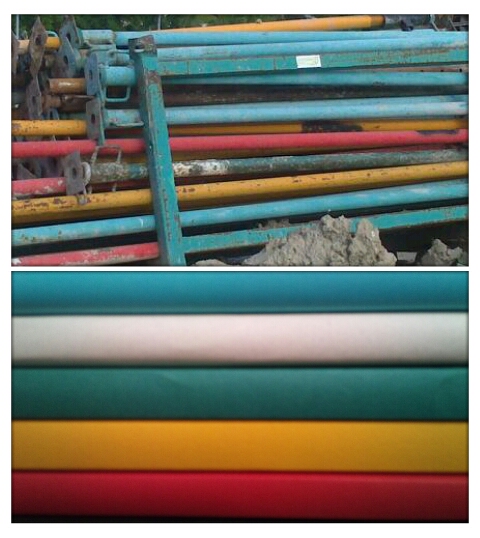
‘The Raw and the Cooked Collage’ from Spain by Ester Conrat, devotee of Archipelago, for the benefit of those of you ‘in the know’.
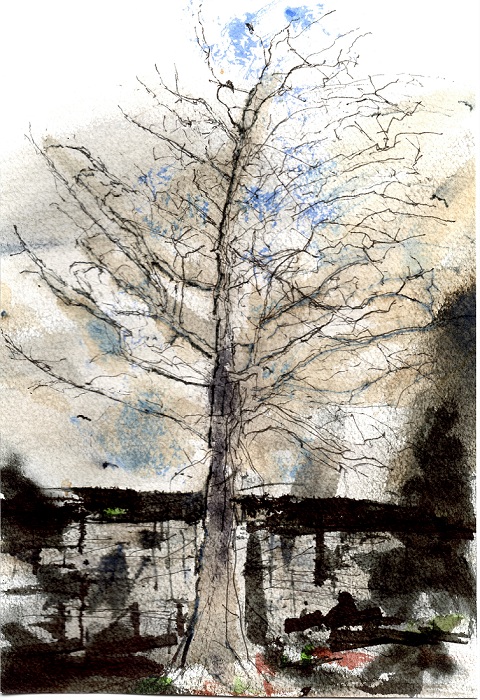
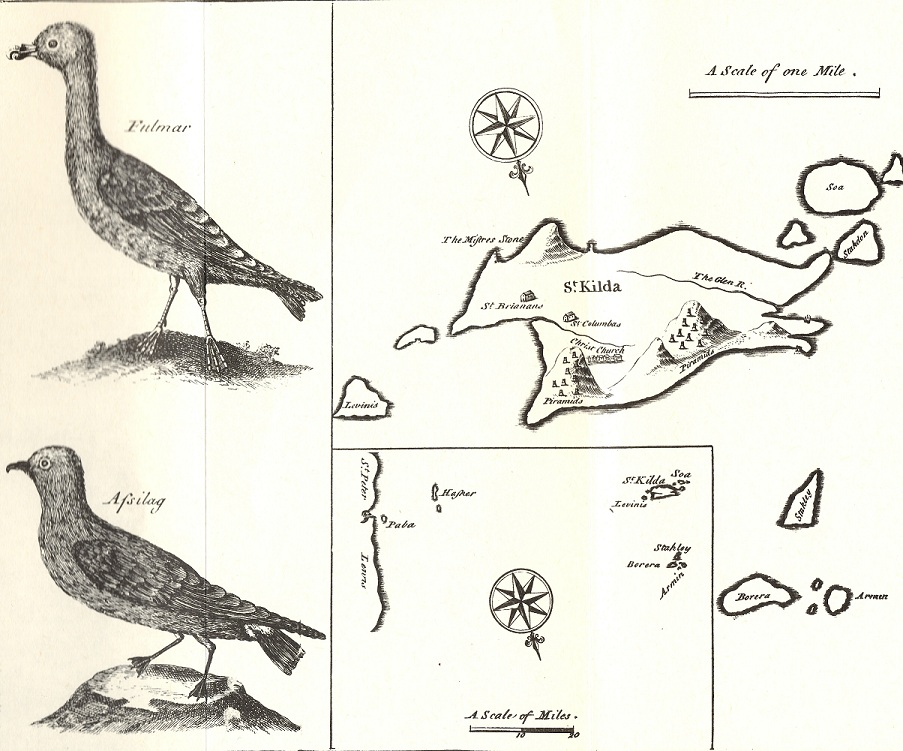
The New Year is already well underway. The long-hand on the clock is stretching towards the light, as a drowning person’s hand might reach for rescue. Spring is beginning to bury its dead. The evenings delay their roosting little-by-little. And when night at last rises up in the shadows and thickens, on come the desk-lamps, out come the maps and charts, and the serious dreaming begins, in the best spirit of Baudelaire’s ‘Le Voyage’. You should not wish your life away. You only have one. But I would throw all the days between now and the end of May overboard, if I could, and put out this moment from Leverburgh, on Harris, for St Kilda. That is my plan, if the two-day window I’ve booked opens on accommodating seas. In some ways to embark for St Kilda is nowadays almost as hackneyed as setting out to climb Everest. But I’ll turn a blind eye to all that and seal myself away into the experience. Before I go I’ll glue into my notebook for handy reference a photocopy of the little map of the St Kildan archipelago from Martin Martin’s A Late Voyage to St Kilda (1698). The earliest map of the islands we have, it’s posted here (with its accompanying quaint drawings of Fulmar and Assilag (Petrel)). Martin sailed in the company of a man called Campbell and so shall I, but not in an open boat ‘to the almost manifest hazard of his life’ (Donald J. Macleod), nor ‘on a mission to pacify the recalcitrant inhabitants of the most remote island in the Hebrides’ (ODNB entry on Martin).
Meanwhile, needs must, and Clutag is busy not only commissioning Archipelago 8 for later this year – having already netted some remarkable work and being almost home and dry – but also making ready at the end of March to publish REVENANTS – Alan Jenkins’s sixth collection of poems; and John Fuller’s sonnet sequence Sketches from the Sierra Tejeda (in a new for Clutag pocket format).
Derailed a little in producing ARCHIPELAGO: THE DOCUMENTARY we have readjusted our timetable and now hope to have the finished product before the year is out or sooner, if possible, to coincide with publication of Archipelago 8.
Advance ordering functions via the website for the new publications will be available shortly. PLEASE NOTE : Clutag Press now has a Facebook page. Tell your friends.
23rd February 2013
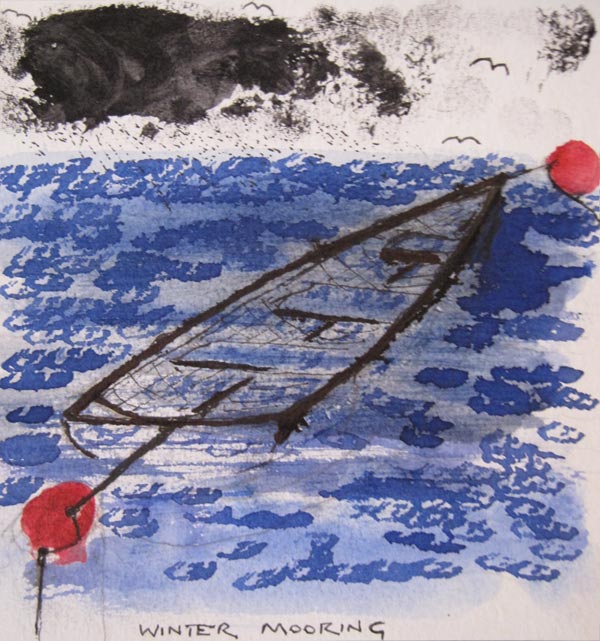
Anchored stern and bow, sea-logged to the gunwales:
So I have moored my mind for the winter ahead.
To be the more sea-worthy if all else fails
Come better weather and spring buries its dead.
13th December 2012
Douglas Dunn (Scotland’s greatest living poet), will be giving a reading at an occasion open to the public in the Old Library, All Souls College, Oxford, on 8 November, from 6pm. All are welcome.
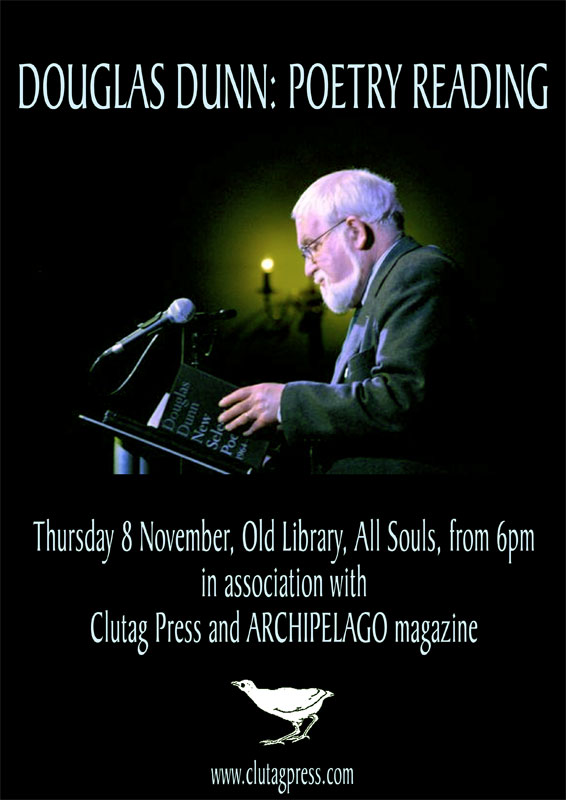
Professor Dunn’s St Kilda’s Parliament (1981) and a long list of his poems about Scotland’s outer limits were an important, long-term inspiration behind the eventual founding of Archipelago in 2007.
Readers will remember that his work first appeared in the second issue of the magazine in the form of a lengthy disquisition – ‘English: A Scottish Essay’ – on the poet’s tongue and its – and his nation’s – relation to the English language. The poem ends, after more than 250 lines, as follows:
One day I’ll feel the confidence to grow
Orchids. But let my lilies flourish in
This land and tongue of rain and cloud-shadow.
Lilies and roses too are of my nation.
Thereafter he has become a mainstay to the Archipelago cause, delighting a readership that like him longs ‘for more chances to walk along depopulated shores’, away from the metropolis, ‘in the provinces, where talent is born’. Most notably, at the same time as he celebrates local and national themes, Professor Dunn knocks the parochial into a cocked hat and scourges the ready and easy way to prejudice. Issue 7 of the magazine will be launched at the same event.
28th October 2012
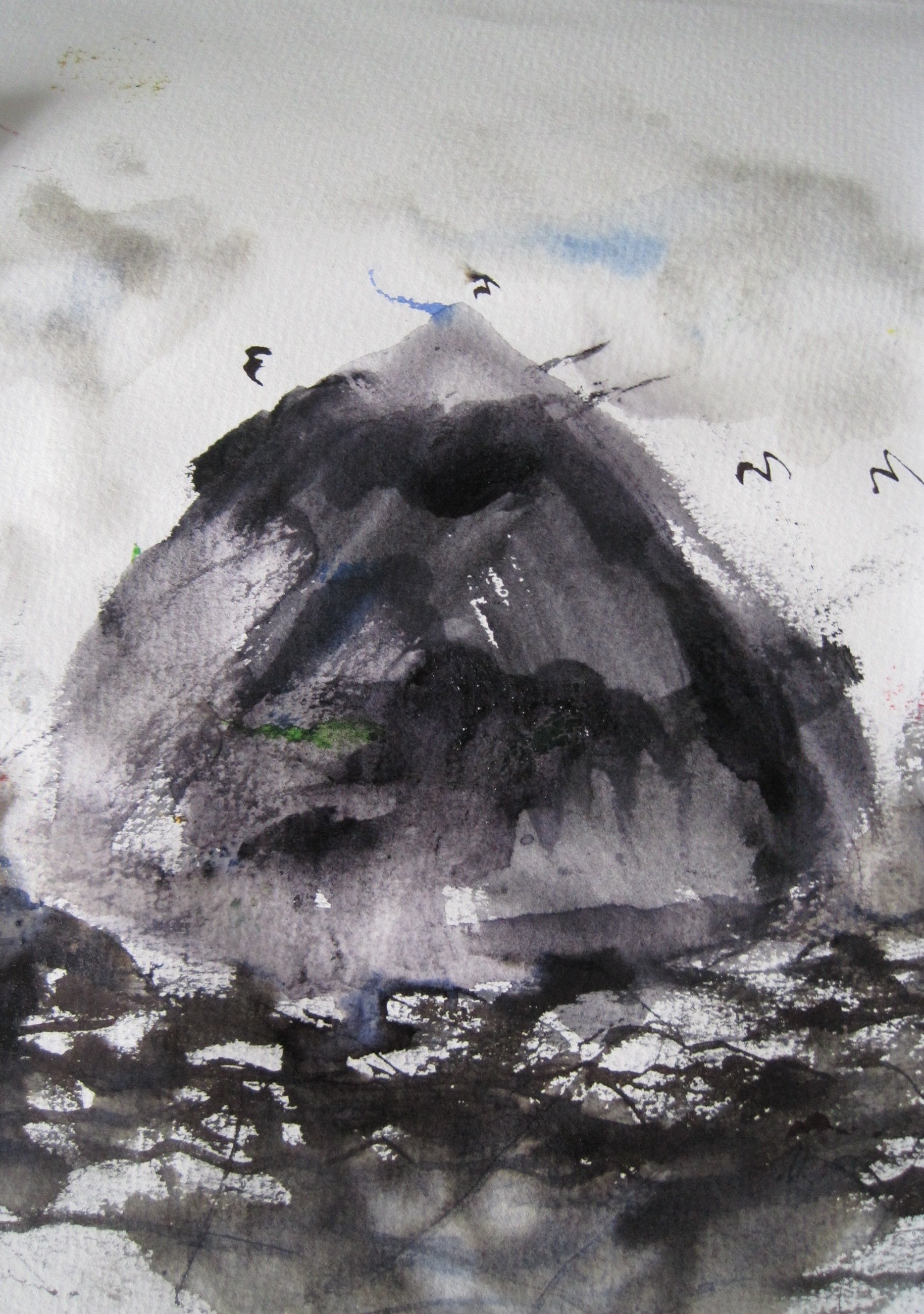
Those of you who have put out to sea aboard ARCHIPELAGO before will know she is powered by an Ailsa Craig. It’s a thing we take comfort in, as she goes plunging after Seeker Reaper (Skipper Hay at the wheel) dirling: Long is sgioba, long is sgioba, gaoth is gillean, gaoth is gillean . . . Now, after so many months at sea I lose count, and down to our last gugha between us, I am pleased to tell you we have glimpsed land. Issue 7 is almost all in the hold, and we’ll be ready in good time for the men in white coats – the fish-market men – as November dawns on the harbour town and the deciduous Atlantic sheds its last leaves before crashing its branches together in earnest, like the spectre of a myriad rutting stags. What the winter seas can do is all nothing new to Ailsa.
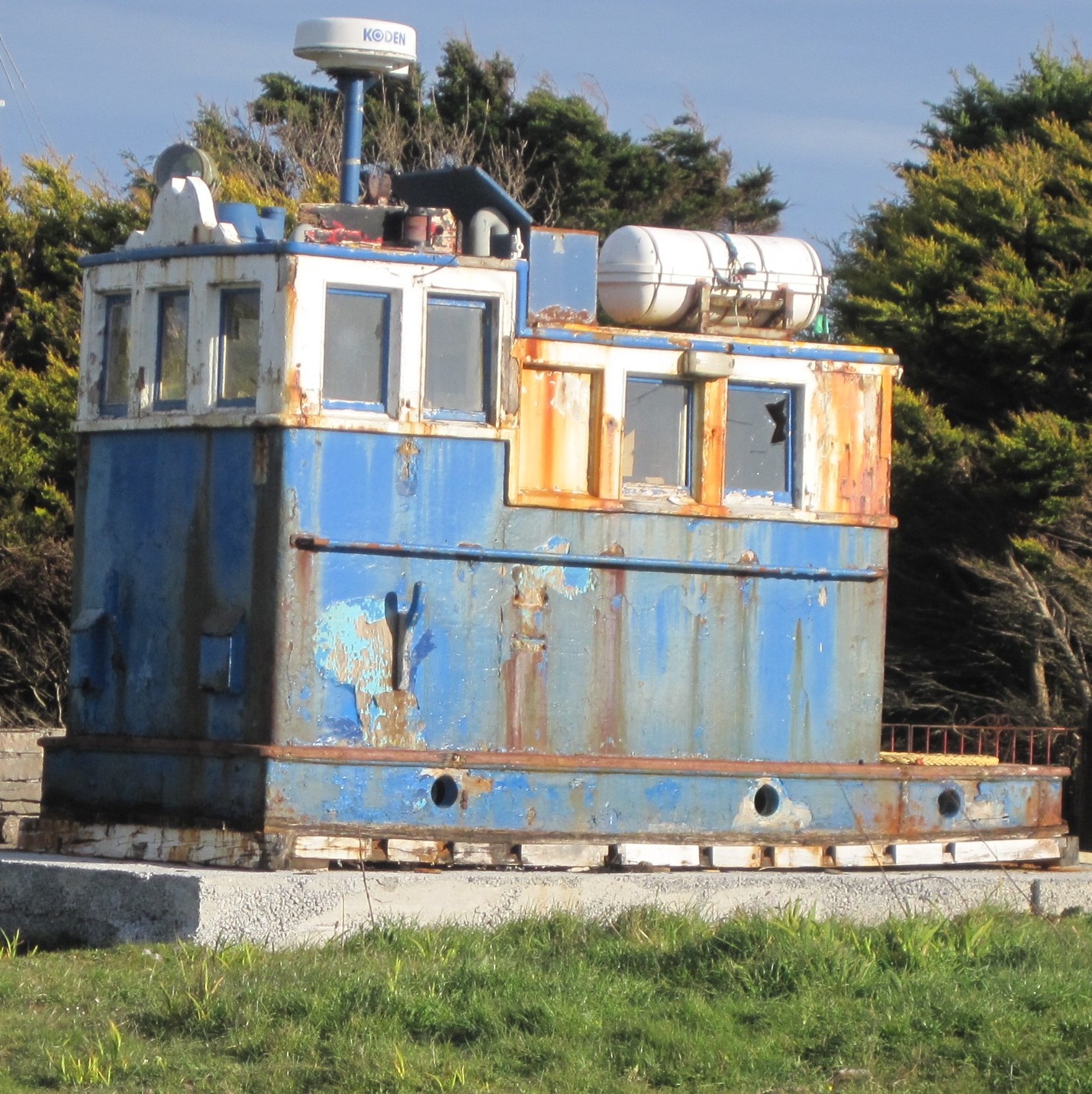
Rumour has reached the office that the great dome – aka Paddy’s Milestone – is up for sale. The consortium that is Clutag-Archipelago is reaching into its empty pockets even as I write. I cannot think of a better spot on which to build our new headquarters: I have in mind a green-granite structure with a roof sown with wild grasses and heathers – nothing but native materials and driftwood timbers. ‘Wheelhouse Watchtowers’ of the type shown here – memorials to our shipwrecked fishing industry – will be positioned discreetly at all four main points of the compass round the rock. Once refurbished these will provide en suite accommodation for staff and readers wishing to ‘get away from it all’.
We don’t yet know what the owners are asking for the Craig but will be putting in a bid when the time comes and our hedge fund bears fruit this autumn of our deep content. But I think I have made account of our content and contributors already, last time out. So I’ll keep the rest of my salt dry for the launch.
Clutag Press is beginning to settle with Rody ‘half-bottlespectreoldsealcodboy’ Gorman (see Archipelago 7 – order in advance!) the final arrangement of his ‘inter-tongueing’ versions of the Suibhne (Sweeney) poem, to be published in autumn 2013. So too is Philip Lancaster a short step from recording Ivor Gurney’s songs, poems and poem settings: CD to be available in 2013. Meanwhile Alan Jenkins is at the threshold and nearly done at last with the text of his new book of poems Revenants. Already ahead of him is John Fuller with his pamphlet (in our new pocketable format) Sketches from the Sierra de Tejeda – meditations in a Spanish village ‘where / The mind discovers its reflections and / Decides to forget itself and somehow be them.’ Look out for further updates on these fronts.
The winner of the Clutag-Archipelago Prize will be announced on publication of Archipelago 7 on 8 November.
I am shortly to set off for the stormy Hebrides – to Barra and the Uists, and to Skye and Raasay – solo by ferry, foot, and fate . . . seeking footage for ARCHIPELAGO: THE DOCUMENTARY. I may be gone some time.
3rd September 2012
Geoffrey Hill’s Odi Barbare (see elsewhere on this site) has been shortlisted for the Forward Prize. We send Professor Hill our congratulations and urge readers to order a copy of the book while stocks last. It will not be reprinted.
Archipelago 7 is almost all delivered. We have had to postpone at least two pieces to issue 8 having otherwise exceeded our optimum extent. That is, along the lines of the last three issues. Among the contributors: Tim Dee, John Elder, Seamus Heaney, Roger Hutchinson, James Macdonald Lockhart, Michael Longley, Angus Martin, Sandy Moffat, Les Murray, Katherine Rundell, Robin Robertson, Tim Robinson, and other treats and surprises. Among locations touched on: Kintyre, Raasay, Giant’s Causeway, Rathlin, Connemara, Co. Clare, Vermont, Coventry, London.
We regret to announce that we have been forced to raise our price for the magazine to £12.50 (UK & Ireland) £17.50 (North America & Row). This deeply regrettable measure is made to help us cope with recently hiked postal rates. Subscriptions paid prior to this announcement will not be affected.
We will notify subscribers as soon as the new issue is in the offing – by or in early November. Meanwhile, some recommended reading: Kirsty Gunn The Big Music, Kathleen Jamie Sightlines, Robert Macfarlane The Old Ways, and Ian Hamilton Finlay: Selections edited and introduced by Alec Finlay.
16th July 2012
26 April 2012, Newman House, St Stephen’s Green: ‘Over the Irish Sea’ symposium hosted by University College Dublin – Jos Smith of Exeter University gives a talk about Archipelago, its preoccupations, its contributors, and the idea of ‘critical localism’ as a radical stay against globalism. It is inspiring to have the project of the ‘unnameable archipelago’ given serious attention at such an occasion and among so many high-powered scholars. Otherwise, of course, I try not to be too serious. I have bought a first edition of Tom O’Flaherty’s Aran Men All (1934) of which I’ve only read an excerpt before.
2 May 2012: I’m writing this beside the Atlantic at Port Bhéal an Dúin (Port of the Fort’s Mouth) near Gort na gCappall (Meadow of the Horses) the only village on the south shore of Árainn, one sometimes referred to by the islanders as ‘West Cork’. It is a hot day and after several in which the wind has most unusually sat in the east to north-east without let-up or shift beyond a point or two of the compass. Such sustained steadiness leaves the Atlantic shore relatively quiet. From Bothar na gCreag by which I came, I could see not just the cliffs of Moher but also the Brandon Mountains much farther south. There have been showers and last night it pelted and blustered. I have been here with Tim Robinson. He left yesterday. We walked together for hours, from shortly after our arrival on Sunday 29 April by the 1pm ferry from Ros an Mhíl in Connemara. It was his first return for eight years, he thought, possibly more. I’m not sure it isn’t a little longer, for he had not seen the harbour works, now just about completed. They have transformed Cill Rónain, the island’s capital. They represent Celtic Tiger money well spent and now to be had no more. I have been coming back since 1999, once or – more often than not – twice a year. Apart from the harbour and the fuel and waste disposal depot on the Low Road, nothing has altered that much. Cill Rónain’s bars and immediate accommodations proclaim themselves more garishly than they used to. An anxiety that the new reservoir had drained An Turlach Mór dry once and for all proved unfounded. It is one of the richest and most bio-diverse sites on the island. There has just been very little rain. It doesn’t alter the fact that depot and reservoir might easily have been camouflaged to blend more discreetly into the landscape. ‘Don’t mention the buses, don’t mention the bicycles,’ one of the jarveys urged us. For my part, I won’t. For me the wonder of walking the island with the author of Stones of Aran was too great to bother with anything else, except perhaps the crowing of pheasants where once one might have heard in early May the corncrake. (We heard and saw cuckoos, as of old.) There are pheasants all over the island, madly introduced, I don’t know by whom, in the past ten years or so. Talk about aural pollution, they seem to mock the place. With each call I hear English rural evenings, round about a great estate, summoning up the shades of landowners whose forebears had a stake in oppressingIreland. As he should be, Tim is held in the deepest affection by the islanders, not least for his knowledge of the Irish language. ‘You search in Árainn for Árainn? O Traveller! / in Árainn itself, there is no room for Árainn’ – is not quite true, but certainly not in the company of Tim Robinson. He knows more about the island than all the islanders put together. Our walks by favourite routes to special venues were like living tutorials in place-lore and I will never forget the botanising, especially, in pursuit of elusive species – Limestone Bugle and Pyramidal Bugle which we could not find, because they flower in March and as they die down are all but impossible to trace. On the way to Dún Dúcathair we chewed on sea-spinach – as hot and peppery as water-cress, it leaves you feeling as if you’ve had a full meal – and rock samphire too. But I will write about all this elsewhere, another time.
Tom O’Flaherty has also kept me company. He quotes an old island saying: ‘Is ío ma ní is buáine ná an duine’ – ‘There’s many a thing more lasting than a person’. He is a superb writer, no less than his brother Liam. I see that the O’Flaherty home in Gort na gCappall is currently up for sale, no price given. It ought to be bought for the Irish nation. There is a magnificent memorial to Liam O’Flaherty just across the road from it, so perhaps civil Árainn should rise to the occasion again.
14th May 2012
With Geoffrey Hill’s latest book of poems in the world at last, I’ve been mending my nets these past few days and had a few prospective shots, for target catches around Barra, the Isle of Lewis, Raasay, Ornsay, Kintyre, on south to Rathlin, then down the Irish Sea and round as far as the Llwchwr Estuary, on the North Gower coast. Things bode well to make the new issue different once again, come November’s high seas, with startling new art and other illustrations too. I’ve left some fixed gear out there off Connemara and in the wider Atlantic, with my eye on a couple of catches, but mum’s the word. I’m using monofilament and I’m not after You-know-who (pace Monsieur Coldiron) but big fish nonetheless. Already I hear among the crew some Scots and some Scottish Gaelic; a little Welsh too, but sprats not mackerel, or shellfish rather; and the raucous gull-cries of English city folk (riotously conspicuous consumers) in the urban wilderness or ‘bewilderness’ as I think we should call it. The metropolitan promises well this time, as never before. But I mustn’t show my hand so early and there’s many a slip. I must heed the old man’s advice: ‘Never let the next man ken ye, but haud yer tongue…’ When time comes for the last haul, I will need to slip from harbour before dawn, perhaps in foul weather, so none might see where I’m bound, and come back late, to keep close how many stone I netted on my way – what species of catch I made; what writers, artists and poets I had for crew at the last, until it’s time to publish Archipelago 7 and be damned in the arc-light glare of the dawn fish-market. Truth is these are hard times everywhere and we’re scraping the bottom at present. Even the barnacles are complaining. It’ll be a while before liquidity floats us on its spring tide, but given time it will, and all manner of thing shall be well. Meanwhile I work away, early and late, whistling and humming to myself that old crooner’s standard: ‘Memories are made of fish …’
CAUGHT-BY-THE-RIVER and NEW NETWORKS FOR NATURE – These enterprises continue to be our favourite fellow-travellers. Please enquire after them and support them however you can.
28th March 2012